
You are closing more than ever and selling for less of the day.
At $500K+ in GCI, the real estate assistant vs buyers agent question is a capacity question. One hire buys back your hours. The other serves buyers you are turning away.
This guide gives you a seven-day audit, the true cost of each role, and a side-by-side contribution test. It draws on Ken Goodfellow’s 30+ years of coaching, with well over 1,000 teams coached.
Should You Hire an Assistant or Buyer’s Agent Next?
Hire an assistant next if administrative work is taking the hours you should spend in appointments. Hire a buyer’s agent next if you are turning away qualified buyers and your administrative load is already covered. If both are true, compare the retained contribution of each hire and fund the larger one first.
The two roles solve different problems, cost money in different ways, and ask different work of you:
| What to Compare | Assistant | Buyer’s Agent |
|---|---|---|
| Problem it solves | Your hours are going to administrative work | Qualified buyers are waiting or leaving |
| What it costs | Wages, payroll taxes, tools, and training time | A split, the leads you hand over, tools, and supervision |
| What it needs from you | Documented tasks and a daily handoff | Steady demand, a follow-up process, and weekly coaching |
| How you measure it | Hours recovered and appointments added | Closings and contribution after the split |
| Main risk | Recovered hours get absorbed by more busywork | Leads are spent on an agent who is slow to convert |
Neither role is the right first hire for every producer. Your own numbers decide, and the next section shows you how to collect them.
Your Bottleneck Determines the Role
The right hire removes the constraint that is costing you the most closings today. Find that constraint with a count, and leave opinion out of it.
Your real estate assistant vs buyers agent decision starts here
Run this audit for seven days:
- Log every working hour in 30-minute blocks.
- Mark the administrative hours: work that needs no license and no judgment from you.
- Count the buyer appointments you declined, delayed, or handed to someone outside your business.
- Mark the owner-only hours: listing appointments, negotiations, and key relationships.
- Total each column.
As a working guide, 10 or more administrative hours in the week points toward an assistant. Three or more qualified buyers declined or delayed, with your paperwork under control, points toward a buyer’s agent. Run a second week before you commit, because one week can mislead.
Be strict about the word qualified. A qualified buyer has financing in place, a timeline, and a reason to move. Casual inquiries inflate the count and make a buyer’s agent look necessary before the demand is there.
If both counts are high, you have two constraints. Skip the debate about which role is better and run both through the contribution test later in this guide.
Another team’s hiring order is their answer
A team down the street hired a buyer’s agent first and grew. Their lead flow, their price point, and their systems produced that result. Copy the order without the conditions, and you inherit the cost without the return.
Commission-only still costs money
An agent on a split draws no salary. The cost shows up elsewhere:
- The leads you paid for and handed over
- Your hours spent training and reviewing deals
- Tools, insurance, and transaction support
- Your name on every client experience that agent delivers
Administrative Support Must Restore Productive Time
An assistant pays off when the hours you recover turn into appointments. If the recovered time fills with more busywork, you added payroll and kept the problem.
When hiring a real estate assistant restores selling time
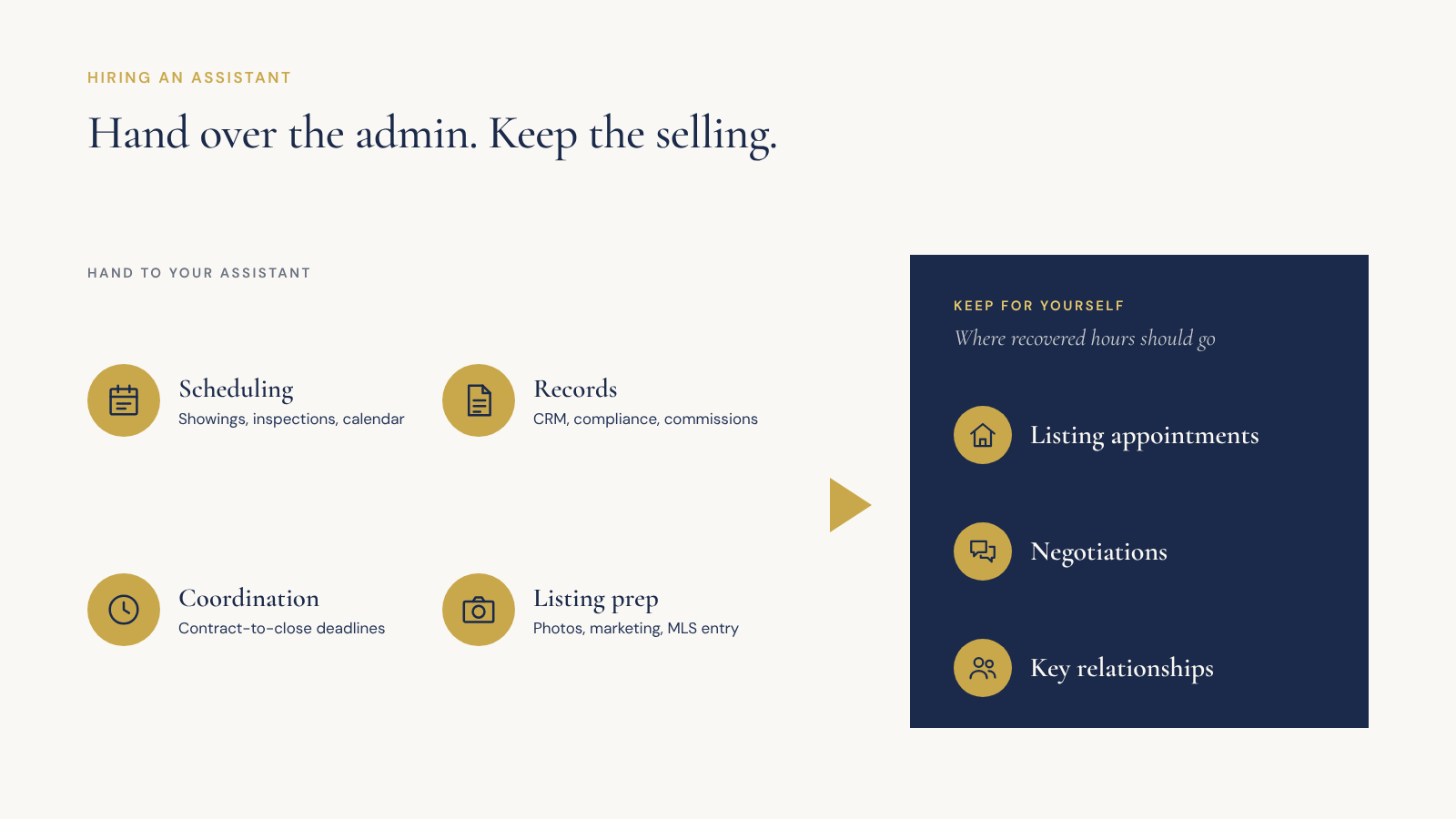
Hiring a real estate assistant works when you hand over complete tasks with a written process. Start with the administrative workload your audit surfaced:
- Scheduling: showings, inspections, appraisals, and your calendar
- Records: CRM updates, file compliance, and commission paperwork
- Coordination: contract-to-close deadlines and vendor follow-up
- Listing preparation: photography bookings, marketing inputs, and MLS entry
Keep the owner-only work. Listing appointments, negotiations, and your key relationships stay with you, and the assistant’s job is to protect the hours they need.
The first 30 days decide whether the hire holds. Hand over one documented task at a time, meet for 15 minutes each morning, and move a task off your list only when the assistant has run it start to finish without you.
Define the scope by license status before day one. California’s Department of Real Estate puts it plainly for its state: unlicensed assistants can help licensees in many ways, but they may perform no activity that requires a license, and they need adequate supervision. Every state draws its own line, so confirm the rules with your broker and your regulator.
The usual objection is “An assistant generates no revenue.” Test it. Record your weekly appointment count before the hire. Review it at 30 and 60 days after. If recovered hours became listing and buyer appointments, the assistant produced revenue through you.
If the count stayed flat, the issue is how you spend the time, and another hire will leave it unsolved.
In the real estate assistant vs buyers agent comparison, the assistant is the hire with the smaller downside. It is also the hire that depends most on your own discipline with the recovered time.
Buyer Agents Need Demand and Support
A buyer’s agent pays off when you have more qualified buyers than you can serve and a process the agent can follow. Buyer-agent readiness describes your business as much as the person you hire. Verify four conditions first:
- Qualified demand: count the financed, motivated buyers you declined or delayed over a full quarter. A steady surplus supports another agent. A busy month does less.
- Documented follow-up: the agent needs your lead response standard, your CRM stages, and your scripts in writing.
- Supervision: name who reviews the agent’s pipeline every week, and confirm how your broker oversees the agent’s licensed activity.
- Contribution after the split: model what the company keeps on each closing before you set the offer. Set agent splits from your own numbers.
Written buyer agreements belong in the training plan. Under NAR’s practice changes, an MLS participant working with a buyer has needed a written agreement before touring a home since August 17, 2024. That is standing practice. Your new agent should present the agreement with confidence from the first appointment.
Plan for the ramp. For the first months, the agent shadows your appointments, you review every offer, and you field the questions. Those are selling hours you give up. Decide in advance which buyers go to the agent and which stay with you, by price point, source, or area, so the handoff follows a rule.
Ken Goodfellow’s clients often say a version of this in their first 30 days: “I always thought I had good systems, but it turns out I had none.” A buyer’s agent exposes that gap fast. Your leads, your reputation, and your time are all on the line while the agent learns.
Compare Retained Contribution Before Committing
Put both hires through the same test: what the company keeps after every cost of the role. The hire with the larger, more certain retained contribution goes first.
Ken reviews financial performance, structure, and founder dependency together, because a hire touches all three. His target is a 40% profit margin on revenue. A hire that grows GCI and shrinks the margin is a step backward. See how each role sits in your team structure before you post the job.
The two scenarios below are illustrations with round numbers. Replace them with yours.
Scenario one: the assistant
Start with fully loaded hiring costs. The Bureau of Labor Statistics reports a median annual wage of $48,310 for secretaries and administrative assistants as of May 2025. That is a broad national occupation figure, and real estate pay in your market will differ.
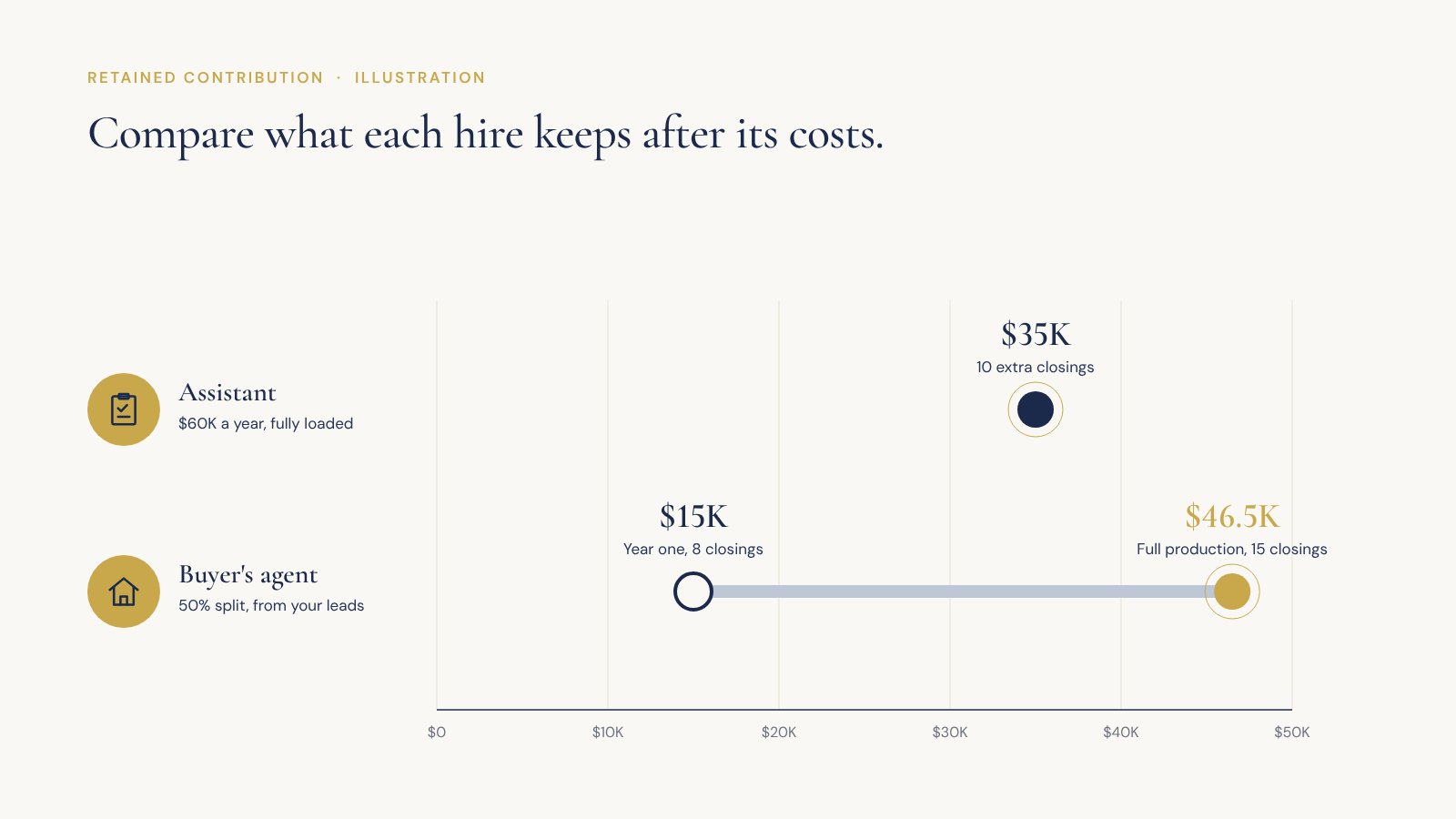
Assume $50,000 in wages plus $10,000 in payroll taxes, benefits, and tools: $60,000 a year. Your average closing brings $10,000 in GCI, and you keep about $9,500 after transaction costs.
Break-even is about six extra closings a year. If recovered hours produce 10 extra closings, the hire adds $95,000 and retains $35,000 after its cost.
Scenario two: the buyer’s agent
Assume the agent closes 15 buyer sides a year from your surplus at $10,000 in GCI each. On a 50% split, the company receives $75,000. Subtract $15,000 for the leads, $7,500 for transaction support, and $6,000 for tools and insurance. Retained contribution is $46,500.
Now run the first-year version. At eight closings, the company receives $40,000. After the same lead and tool costs and $4,000 in transaction support, it retains $15,000.
Read the two together. The buyer’s agent wins at full production and loses during the ramp. The assistant returns less at the top and carries less uncertainty. Your audit tells you which scenario your demand can support.
The math leaves founder dependency out
The dollars are half the comparison. An assistant lowers the number of tasks that need you. A buyer’s agent adds a person who needs your leads, your coaching, and your review.
If the business already stalls when you take a week off, add support before you add production. If your administrative side runs without you and buyers are still waiting, the agent is the stronger case. That is the practical answer to real estate assistant vs buyers agent at this level: fix the constraint the audit found, then prove it with the numbers.
These scenarios are illustrations. They carry no guarantee of GCI, profit, or results in your business.
Give Your Next Hire a Measurable Purpose
The real estate assistant vs buyers agent decision comes down to one constraint and one number. Keep three points:
- Audit your week before you write a job description.
- Hire the role that removes your largest constraint.
- Set the measure in advance: appointments added for an assistant, contribution after the split for an agent.
If you are answering emails at 10 p.m. and sending buyers to other agents in the same week, you have both problems. The math above tells you which one to fix first.
Coach Ken helps top real estate agents, team leaders, and broker-owners run their businesses like CEOs. That is the work of real estate team coaching. Where the Best Get Better.
Plan the hire inside your growth plan. Get Scaling Your Real Estate Business and map your next role before you make the offer.