
Coaching pays when your profit gap is larger than the fee.
Top producers ask the question quietly: is real estate coaching worth it? The volume is real. The profit, the hours, and the team tell a different story than the one the market sees.
This guide is for operators at $500K or more in GCI and leaders of $2M to $10M teams. It shows what 1-on-1 coaching looks like in practice, who it serves, who should wait, and how to judge the cost against your own numbers.
It draws on Ken Goodfellow’s 30+ years of coaching the top 1 to 5 percent, including well over 1,000 teams and 600+ broker-owners.
Is Real Estate Coaching Worth It for an Established Team Leader or Broker-Owner?
Real estate coaching is worth it for an established team leader or broker-owner when it closes a profit gap larger than its annual cost and you are willing to change compensation, structure, and habits. It is a poor investment for anyone who wants motivation, scripts, or validation of how the business already runs.
So the decision is arithmetic before it is anything else. Put two numbers side by side:
- Your profit gap: the difference between what the business keeps today and what it should keep.
- The annual cost of coaching: fees plus the hours you will spend on the work.
- The decision: if the gap is several times the cost and you will act on the plan, the case is strong. If you are unable to estimate the gap, start by getting your numbers clear.
Here is an illustration from Ken’s own benchmarks. His target for a client business is a 40% profit margin on revenue. A team at $5 million in GCI should keep at least $1.2 million. A team at that level keeping $180,000 has a gap of about $1 million a year. The full breakdown is in the guide to team profitability.
Estimate your own gap in three steps:
- Take your profit for the last 12 months from the P&L.
- Multiply your revenue by your target margin.
- Subtract the first number from the second. That is the yearly price of leaving the business as it is.
Outside data points the same direction, with limits. A 2014 Inman survey of 997 brokers and agents found that more than 9 in 10 said their business grew 10% or more in their first year with a coach, and more than half reported growth above 25%. The survey is self-reported, more than a decade old, and covers agents at every level. Treat it as context, and let your own P&L decide.
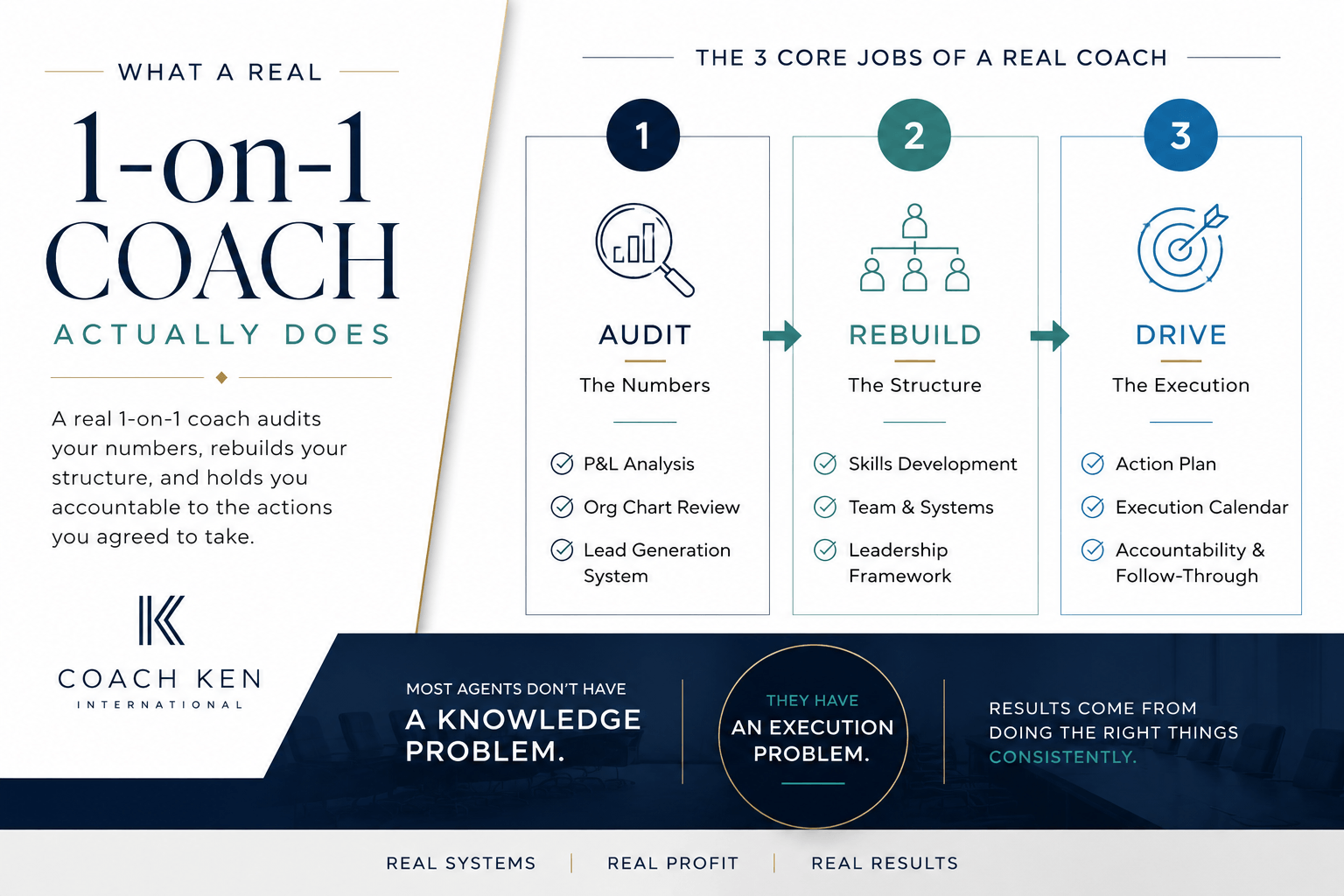
A 1-on-1 Coach Works on Three Parts of Your Business
A real estate coach working 1-on-1 does three jobs: audits your numbers, rebuilds your structure, and holds you to the actions you agreed to take. Events, slogans, and scripts are extras.
With every new client, Ken Goodfellow looks at three items first: the P&L, the organizational chart, and the lead generation system, in that order. The P&L shows where profit leaks. The chart shows who decides what. The lead system shows whether business arrives every day or only when the owner pushes.
Each review turns up specifics. On the P&L, it is often a split set years ago for an agent whose production has since dropped. On the chart, it is a function with two bosses or none. In the lead system, it is a database nobody has contacted in a year.
At Coach Ken, that diagnosis is the Clarity Intensive, a focused engagement built on a detailed assessment and a private strategy session. The ongoing work is Strategic Advisory, with private monthly sessions, KPI tracking, and quarterly planning.
The work then runs on three tracks:
- Action over theory: you already know part of what to do. The plan turns it into dated commitments.
- Skills: winning a high-stakes listing presentation, landing a producing recruit, and holding a hard conversation about splits.
- Succession and luxury: the two areas where owner decisions carry the most money, and the two that general coaching skips.
His definition of the third job is short: “Accountability is simply doing what you said you are going to do. That is all.”
The First Three Months of 1-on-1 Coaching Follow a Set Order
Sound 1-on-1 coaching starts with diagnosis, moves to structure, and then holds the plan to account. The order matters, because changing structure before you read the numbers is guessing.
Month one is diagnosis
You hand over the P&L, the org chart, production by agent, marketing spend by source, and a snapshot of the database. The first sessions map four problems: where profit leaks, where your time is trapped, where the team drags, and where succession risk sits. You leave the month with a written diagnosis and a short, ranked list of actions.
Month two is structure and systems
Roles and reporting lines come first. Splits follow, set against your profit target and your own accounting. Then come daily lead generation standards for you and for every producer. You leave the month with a revised chart, a compensation model, and written standards.
Month three is accountability
You review the P&L against the plan. Did the role changes happen? Did recruiting move? Did the marketing cuts hold? Early signs are steadier cash flow, fewer emergencies, and more of your week spent on leadership.
After that, the rhythm is steady: a monthly review of numbers and actions, and a quarterly reset of priorities. The value compounds through repetition with someone who has seen your pattern before.
1-on-1 Coaching Serves Operators With Revenue and Real Problems
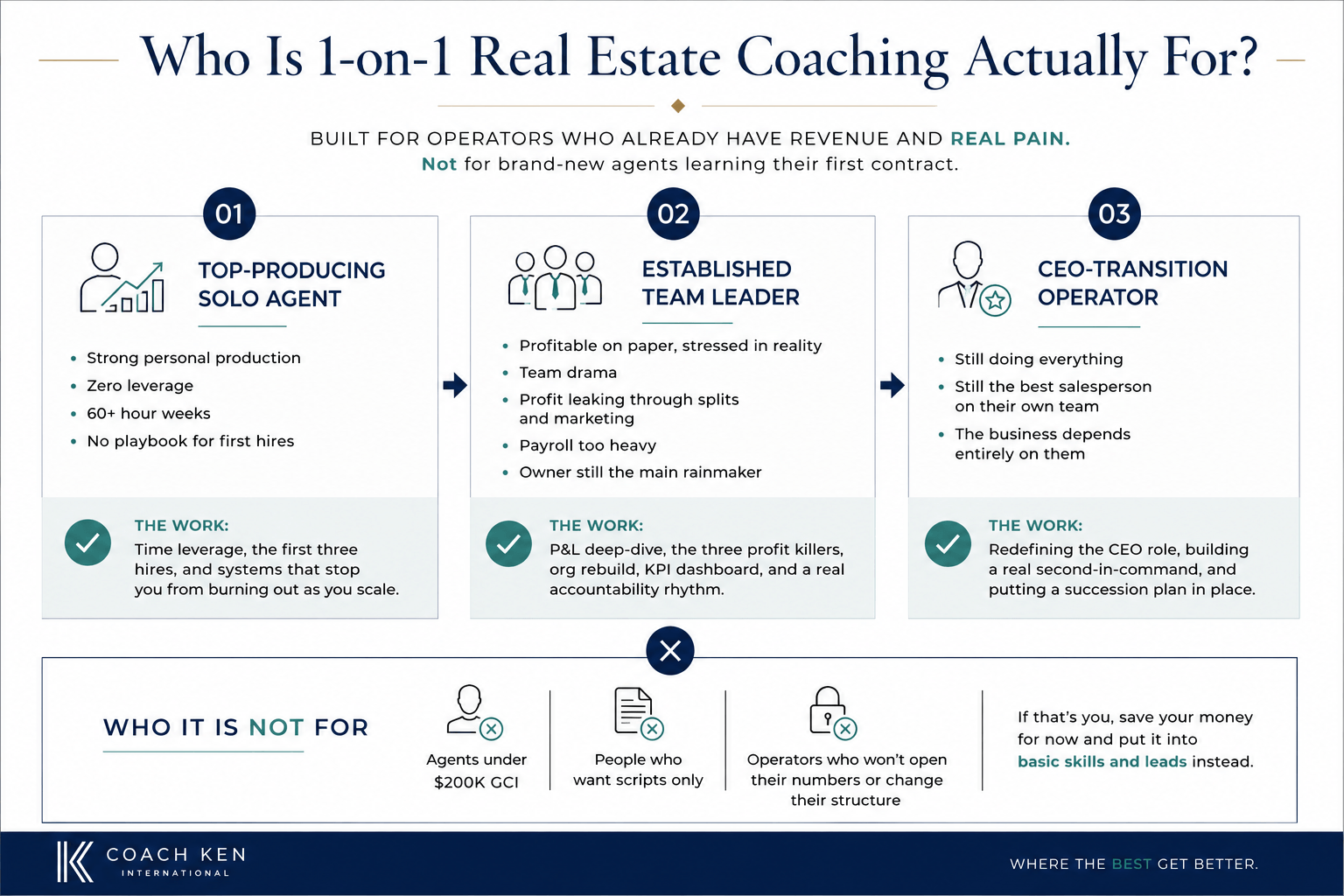
Private coaching is built for people who already have a business and a specific problem inside it. Four profiles come up most often:
- The top-producing agent at $500K+ GCI: strong production, 60-hour weeks, and no plan for the first hires. The work is time, delegation, and the first roles.
- The established team leader at $2M to $10M: profitable on paper, with profit leaking through splits, marketing, and payroll, and the owner still the main rainmaker. The work is the P&L, compensation, and an accountability rhythm.
- The broker-owner: compressed margins, hard recruiting, and a business that runs because the owner is in it every day. The work is margin, recruiting standards, and leadership depth.
- The CEO-transition operator: still the best salesperson on the team, with no second-in-command and no succession plan. The work is redefining the owner’s role and developing the next leader.
Three groups should wait:
- Agents still building consistent lead flow. Skills training and repetition come first.
- Anyone who wants scripts and motivation more than a spreadsheet.
- Owners who will keep the books closed or the structure unchanged.
The filter runs both ways. Ken turns down approximately 20 prospective clients a month who fall outside his criteria.
Private Coaching, Group Programs, and Courses Solve Different Problems
Each format is good at one job. Group coaching and courses deliver information to a large audience efficiently. Private coaching puts one experienced set of eyes on your business.
| Format | What You Get | Where It Stops |
| 1-on-1 coaching | A plan built on your numbers, private sessions, and accountability to agreed actions | It costs more, and it works only if you change how the business runs |
| Group coaching | A curriculum, a community, and peer accountability | The content stays general, and nobody reads your P&L |
| Courses and free content | Skills and ideas you can replay at any time | There is no feedback and no pressure to implement |
Anyone asking is real estate coaching worth it should add a second question: compared with what? The useful comparison is with the cost of staying in a general program that never touches your structure. For a wider view of the options, see the best real estate coaching programs. For the selection criteria, read how to choose a real estate team coach.
Results Depend on Execution, and the Range Is Wide
Coaching produces a plan and pressure to carry it out. The client produces the result. Three confirmed outcomes from Ken’s clients show the range:
- A brother and sister with a good business wanted out. They kept going, made more money, took more time off, and built a multi-million dollar business.
- A client in California went from $4 million in GCI to $14 million within two years.
- A client who sells large houses went from $2 million in revenue to $5 million in the first three months of a year.
These are individual results. They depend on the business, the market, and the owner’s execution, and they carry no guarantee. More client results are on the clients page.
Coaching leaves market cycles in place. It makes the business less dependent on them. Ken started in the industry when rates were 22 percent and built on systems that worked in any conditions.
The gains clients describe to the people they refer go past income: “They’re making a lot more money and working less. They’re having a better life.”
Judge the Cost Against the Profit You Are Losing
The right question about cost is what the engagement covers and what the gap costs you each year you leave it open.
Scope comes first. Ask what is reviewed, how often you meet, who does the work, and what you will hold at the end of each quarter. Fees for any program are confirmed directly with the provider, and Ken’s are set on a Discovery Call after the diagnosis. The wider cost picture is covered in what real estate coaching costs.
Three scope questions separate serious programs from content subscriptions. Will the coach read my financials before advising me? Will I work with the named coach or with staff? What will be different in my business at the end of the first quarter, in writing?
Industry margins explain why the question matters. AccountTECH’s study of 157 brokerage companies found a median EBITDA margin of 1.68% of income in 2025. In a business that thin, a structural fix is worth more than another year of volume.
Set that against your gap, and the question of is real estate coaching worth it becomes a comparison of two annual figures. You are ready if all three are true:
- You are at $500K or more in GCI, or you lead a $2M to $10M team.
- You have at least one of these: a profit leak, team disorder, a time trap, or succession worry.
- You will share your numbers, change compensation, and make hard personnel calls over the next 12 months.
Your Numbers Answer the Question
Is real estate coaching worth it? Your P&L answers faster than any opinion. Keep three points:
- Compare the annual cost of coaching with your annual profit gap.
- Choose 1-on-1 coaching when the problem is structural and specific to your business.
- Expect results in proportion to what you are willing to change.
If your revenue looks strong from the outside and your take-home, your hours, and your team disagree, you already have the reason to look.
Ken has been personally involved in 50+ company sales and succession transactions, and he built and sold his own brokerage with approximately 200 agents. Coach Ken helps top real estate agents, team leaders, and broker-owners run their businesses like CEOs. Where the Best Get Better.
Start with your own numbers. Request your Free Business Evaluation today.