
A coaching fee tells you the price. It tells you little about what you get.
If you are searching for an alternative to Tom Ferry coaching, you are probably past scripts and events. You run real volume, and you want help with profit, structure, and exit.
This guide compares your options on four criteria: operator experience, a review of your own numbers, a stated profit target, and a plan for succession. It also lays out what coaching costs today. It draws on Ken Goodfellow’s 30+ years of coaching, with well over 1,000 teams coached.
What Alternatives to Tom Ferry Coaching Should an Established Real Estate Operator Compare?
An established operator should compare four alternatives: private advisory led by a coach who has owned and sold a real estate business, a peer boardroom of top producers, specialist coaching for one function such as luxury or succession, and a different tier of the current program. Judge each on what it examines in your business.
- Operator-led private advisory. At Coach Ken, this is Strategic Advisory, which begins with a full review of financial performance, team structure, leadership, recruiting, marketing, and operations.
- A peer boardroom. A small room of operators at your level, such as the Billion Dollar Boardroom, where the comparison is with businesses like yours.
- Specialist coaching. Focused help on one high-stakes area: luxury positioning, succession, or team systems.
- A different tier of your current program. If the method works for you and the problem is access, more private time may be the answer.
The first question to settle is what you are buying. More tactics and a rebuild of how the business runs are two different purchases.
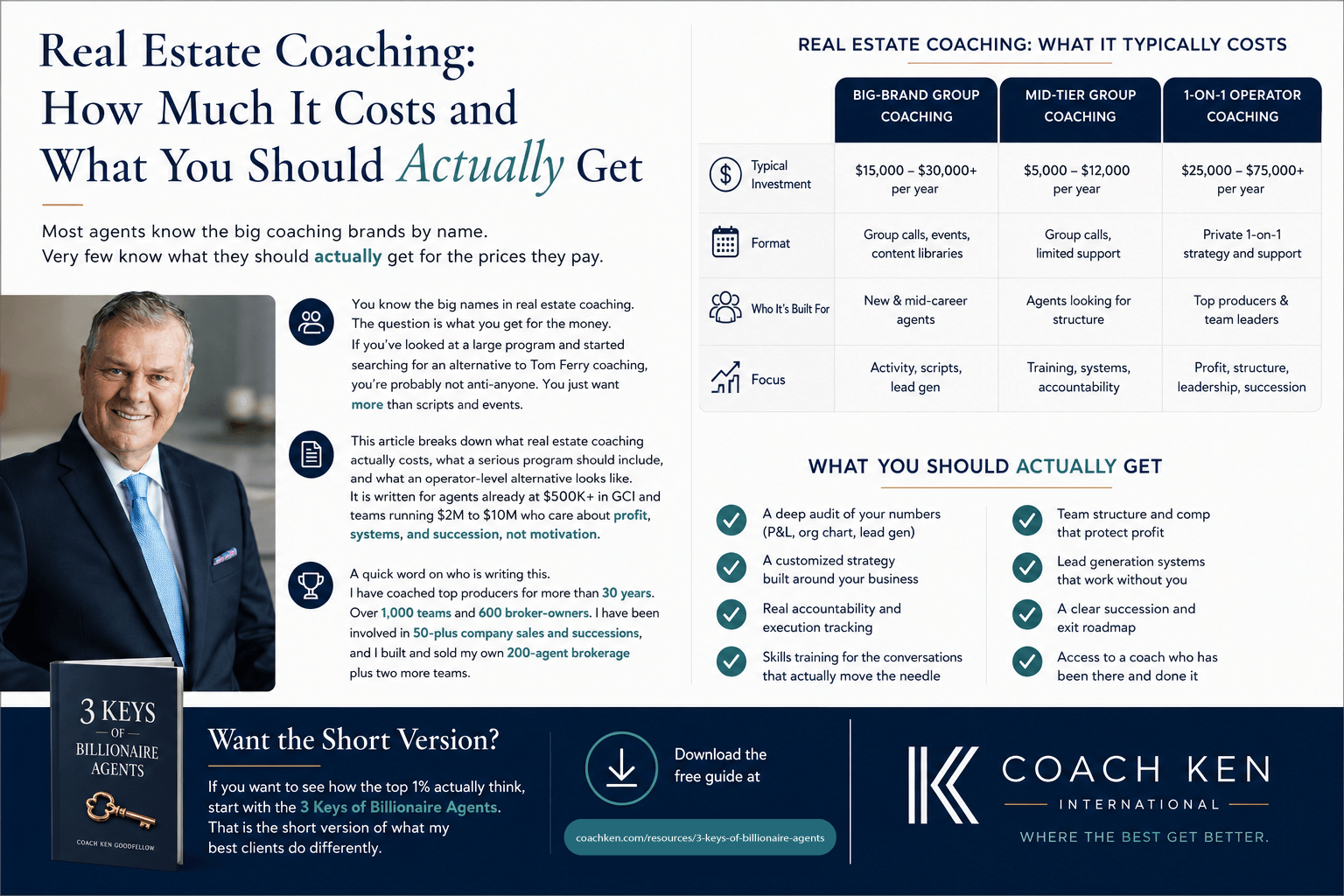
Real Estate Coaching Cost Runs From Hundreds to Thousands a Month
Real estate coaching cost depends on the format, the access you get to a senior coach, and how much of the work is built around your business. Published figures give the range:
| Format | Published Price | Source |
| Group coaching | $200 to $750 a month | The Close, 2026 guide |
| One-on-one coaching | Starts around $750 a month and rises with the coach and the depth | The Close, 2026 guide |
| Tom Ferry Core | $749 a month, with 24 private sessions a year | Tom Ferry’s website, as of August 2026 |
| Tom Ferry Elite | $1,299 a month, with 48 private sessions a year | Tom Ferry’s website, as of August 2026 |
| Tom Ferry Team Coaching | Quoted on consultation | Tom Ferry’s website, as of August 2026 |
| Coach Ken private advisory | Set on a Discovery Call after the scope is defined | Coach Ken International |
HousingWire’s review of coaching programs puts it this way: most programs cost more than $500 a month, and some charge several thousand. The Close’s 2026 guide gives the group and one-on-one ranges in the table.
The Tom Ferry figures come from the company’s own published pricing as of August 2026, and tiers change, so confirm them before you decide. Its Team Coaching is quoted on consultation.
Ken’s fees appear in no public list. The scope is defined first, from the diagnosis, and the fee is confirmed on a Discovery Call.
Three factors move the price in every program: group or private delivery, how senior your coach is, and how many sessions, events, and tools are bundled in. Compare programs on the same three before you compare the monthly number.
The annual figure is the real price
Convert every quote to a year. A $749 monthly plan is $8,988 a year, and a $1,299 plan is $15,588, before travel to events and the hours you spend in sessions. Ask about the contract term and the cancellation terms as well, because a 12-month commitment changes the decision.
The fee matters less than the result it buys
Here is an illustration. On $5 million in GCI, one point of profit margin is $50,000 a year. A program that moves your margin by a single point returns $50,000 a year against its fee. A program that leaves your margin where it was costs you the fee and the year.
Big-Brand Programs Do Specific Jobs Well
Large coaching companies are built to serve thousands of agents, and that scale is a strength for the right client. A fair comparison starts with what they deliver.
- Structure: scheduled private sessions, group calls, and a defined curriculum. HousingWire describes Tom Ferry’s programs as focused on its “8 Levels of Performance.”
- Accountability: a regular call with a coach who checks activity against the plan.
- Playbooks and tools: scripts, marketing plans, and lead generation methods that are tested across a large base of agents.
- Community and events: a wide peer network and large conferences.
That model serves agents who need volume, habits, and proven systems. Its limit shows up later. A program built for scale has to stay general, and a complex business needs someone to read its P&L.
Three signs tell you the program has stopped serving your stage. Your goals for this year match last year’s. Your sessions cover activity counts while your margin slips. And your coach has never asked to see your financials.
An Alternative to Tom Ferry Coaching Should Pass Four Tests
A serious alternative to Tom Ferry coaching is defined by what it examines, and a lower price is the wrong reason to switch. Run every option through four tests:
- Operator history. Has the coach owned and sold a brokerage or a large team, or only run a training company? A strong answer names the business, its size, and the sale.
- Your numbers on the table. Does the work start with your P&L and organizational chart in the first month? A strong answer lists the documents you will be asked to send.
- A profit target. Does the coach name a margin target and measure progress against it, or track GCI alone? A strong answer is a number.
- An exit view. Will the coach tell you whether the business is sellable today and what has to change? A strong answer comes from someone who has been through a sale.
Add one check on the room. If the other members are years behind you, the content will be too. The longer version of this process is in how to choose a real estate team coach.
A Serious Program Delivers Four Results
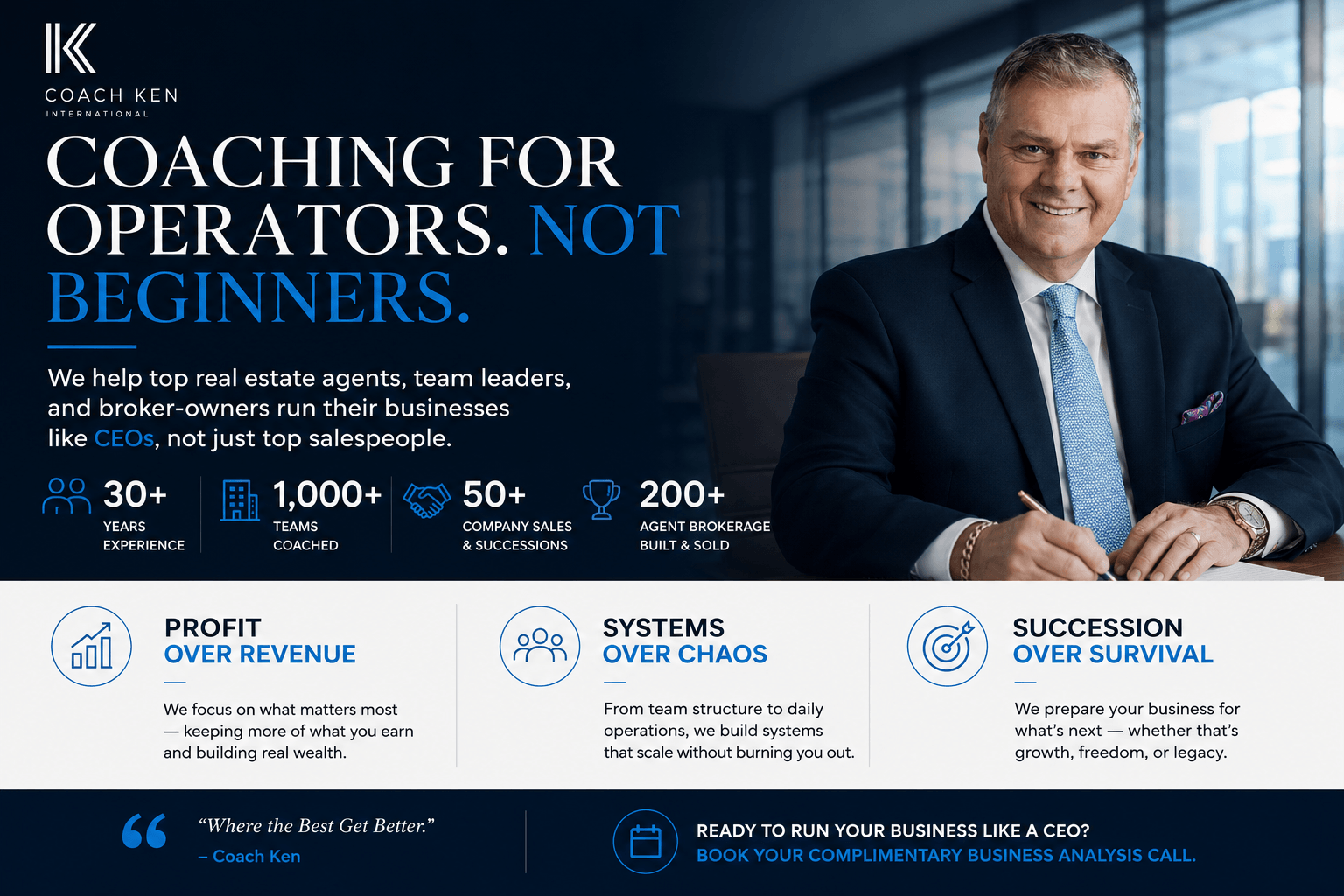
At any premium price, you should receive more than motivation and scripts. Ask each provider to show you four deliverables in writing:
- Strategy: a 12-month plan built on your numbers and your market.
- Systems: operating routines for lead generation, team management, and accountability, with weekly and monthly numbers.
- Profit: a target margin and a path to it. Ken’s target is a 40% profit margin on revenue, which means a team at $5 million in GCI should keep at least $1.2 million.
- Succession: a direct assessment of whether the business could be sold or handed on, and the work required.
Then ask how each one is measured. A plan with no numbers attached is a conversation.
Ask one more question before you sign: what will be different in my business at the end of the first quarter, in writing? A provider who can answer that has a method. A provider who talks about energy and community is selling membership.
Coach Ken Works From the Numbers Out
Coach Ken is a private practice for established operators. The work starts with financials, structure, and succession, and it stays there.
Ken Goodfellow built and sold his own brokerage with approximately 200 agents, and he has been personally involved in 50+ company sales and succession transactions. His coaching rests on three pillars: action over theory, real skills development, and succession and luxury.
He works with top-producing agents at $500K or more in GCI, leaders of $2M to $10M teams, broker-owners, luxury specialists, and owners moving into the CEO role. He also turns down approximately 20 prospective clients a month who fall outside his criteria.
The engagement follows a set path. The Clarity Intensive is the diagnosis: a detailed assessment of the business, a private strategy session, and a prioritized action plan. Strategic Advisory is the ongoing work, with private monthly sessions, KPI tracking, and quarterly planning.
Two confirmed client results show what execution can produce. A client in California went from $4 million in GCI to $14 million within two years. Another went from $2 million in revenue to $5 million in the first three months of a year. Those are individual outcomes, and they carry no guarantee. More are on the clients page.
His view of the industry explains the difference. Too many coaches pick one avenue, such as skills or AI, and skip the complete business view.
Stay or Switch Depends on Your Stage
Switching is right for some operators and wrong for others. Decide by stage and by problem.
Stay with a large program if you are still building volume, habits, and basic systems, or if a big community and live events are what keep you moving. It is the right tool for that stage.
Look at an operator-led alternative if three statements are true:
- You are at $500K or more in GCI, or you lead a $2M to $10M team.
- Your problem is a profit leak, team strain, or the absence of an exit path.
- You want someone to open the P&L and tell you what it says.
If you switch, do it in order. Check the term left on your current agreement. Keep the scorecard and the habits that worked. Get the diagnosis from the new coach before you commit to a year, so you are buying a plan you have seen.
Then compare the yearly fee with the yearly cost of the leak. The method is in the guide that asks is real estate coaching worth it, and a wider field of options is in the review of the best real estate coaching programs.
Pay for a Business Result
The best alternative to Tom Ferry coaching for an established operator is the one that opens your numbers and rebuilds your structure with you. Keep three points:
- Price follows format, access, and depth, so compare those first.
- Test every coach on operator history, your numbers, a profit target, and an exit view.
- Stay or switch by stage, and measure the fee against the leak.
If you have been in a program for years and nobody there has read your P&L, you already know what is missing.
Coach Ken helps top real estate agents, team leaders, and broker-owners run their businesses like CEOs. Where the Best Get Better.
See how the top of the market runs before you choose. Get the 3 Keys of Billionaire Agents.