
Your team is staffed. Routine decisions still land on your desk.
Your real estate team structure names every role, yet a marketing invoice, a client complaint, and a deadline extension all wait for your yes. You built a team to buy back time, and you still work 60+ hour weeks.
This guide shows you how to assign roles and decision rights as you grow: who owns each function, who decides what, and when a decision comes back to you.
It draws on Ken Goodfellow’s 30+ years of coaching, with well over 1,000 teams and 600+ broker-owners coached.
What Real Estate Team Structure Gives Each Role Clear Authority and Accountability?
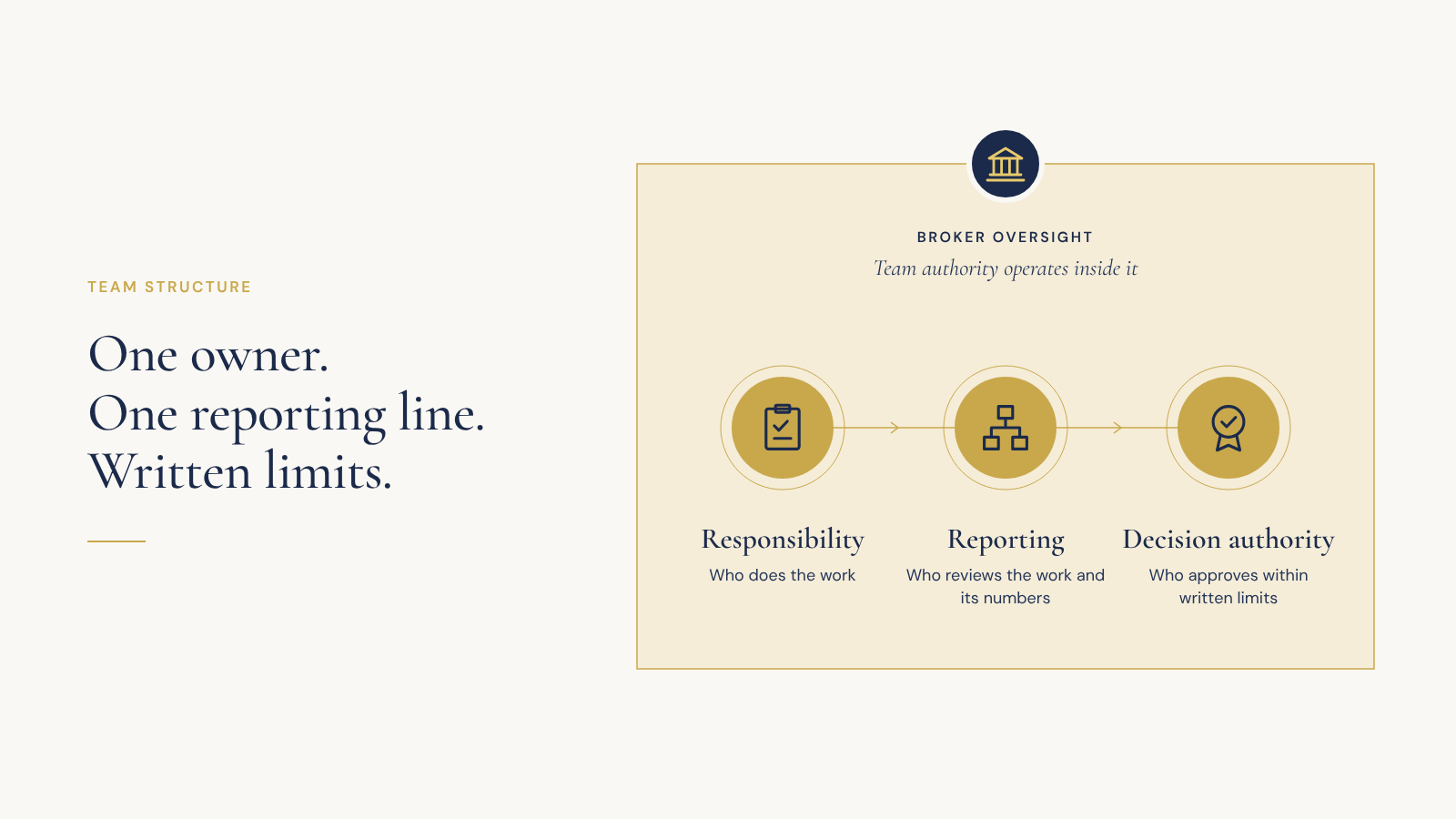
The right real estate team structure gives every function one named owner, one reporting line, and written decision limits. Responsibility defines who does the work. Reporting defines who reviews it. Decision authority defines who approves without asking. Broker oversight stays with your supervising broker for license law, agreements, and advertising, whatever your team chart says.
A chart of job titles tells you who is on payroll. It leaves open who decides. Four terms close that gap, and each one needs its own line in writing:
- Responsibility is the work a role completes. The transaction coordinator opens the file and tracks every deadline.
- Reporting is the one person who reviews that work and its numbers. The coordinator reports to the operations lead.
- Decision authority is the set of calls a role makes without approval, inside written limits. The coordinator approves a routine deadline extension.
- Broker oversight is the supervision your broker holds by law. Team authority operates inside it.
Run one event through all four. A client complains about slow communication. The agent on the file is responsible for the relationship and reports to the sales lead. The operations lead holds the authority to resolve service complaints and answers the same business day. A complaint that raises a license question goes to the broker.
NAR’s legal guidance for teams places supervision of teams with the managing broker, starting with state license law. Check your state’s rules and your brokerage policy before you delegate any decision that touches agency, advertising, or client funds.
Shared Responsibility Keeps Decisions on Your Desk
When two people share a function, you become the tie-breaker. A real estate team structure built on shared responsibility sounds collaborative. In practice, every disagreement, exception, and judgment call travels back to you. Three structural mistakes cause it.
Two bosses create two sets of priorities
An agent who takes direction from the sales lead and the operations lead hears two priorities. The agent picks the easier one, or asks you to choose.
Give every person one reviewer for their work and their numbers. One leader sets priorities.
Overlapping client ownership leaves the client waiting
When the listing agent, the coordinator, and you all own the client, each assumes another made the call. The client hears from three people, or from nobody.
Assign one owner per client at each stage. The agent owns the relationship through contract. The coordinator owns communication from contract to close. The agent takes it back after closing. Write the handoff point down, and tell the client who to call.
Delegated tasks still wait for your approval
You delegated the task and kept the decision. The marketing coordinator builds the campaign, then waits for you to approve the spend. The operations manager drafts the complaint response, then waits for you to send it.
That is delegation of labor. The authority stayed with you, and so did the queue.
Written limits protect service quality
The common objection: “Delegation will reduce service quality.” It will, if you hand over authority with no limits. Service drops when a team member has to guess how far their authority goes.
Written limits remove the guess. Every delegated decision carries three parts:
- The limit: what the role approves alone.
- The standard: what a good outcome looks like, such as every client call returned the same business day.
- The escalation rule: the event that sends the decision up.
With those parts in writing, your standard travels with the decision. The client gets an answer from the person already on the file, and gets it faster.
Give Each Function an Owner Before Adding Payroll
Name one owner for every function before you approve another position. A hire placed into an unclear structure adds payroll and one more person who needs your approval.
Start with the functions every established team runs:
- Lead generation and marketing
- Sales production and conversion
- Transaction management
- Client care after closing
- Finance: the P&L, payroll, and commission processing
- Compliance contact with your broker
Write one name beside each function. Then write the name of the person who makes the final call today. Count how often your own name appears in the second column. That count is your founder dependency, in one number.
Read structure next to the numbers. With every new client, Ken Goodfellow looks at three items first: the P&L, the organizational chart, and the lead generation system, in that order.
His target is a 40% profit margin on revenue. A team at $2M in revenue should keep $800K. A chart that adds roles while the margin shrinks is adding cost, so review each role against team profitability before you add the next one.
The same review sits behind the Clarity Intensive, which examines financial performance, team structure, and founder dependency together.
Skip the universal staffing ratios. NAR’s 2026 Member Profile reports that 21% of Realtors work on a team, with teams averaging four members. That figure describes how teams look today. It says nothing about the staffing your business needs.
Before you approve a position, answer three questions in writing: which function it owns, who it reports to, and which decisions it makes without you.

Your real estate team organizational chart shows reporting lines
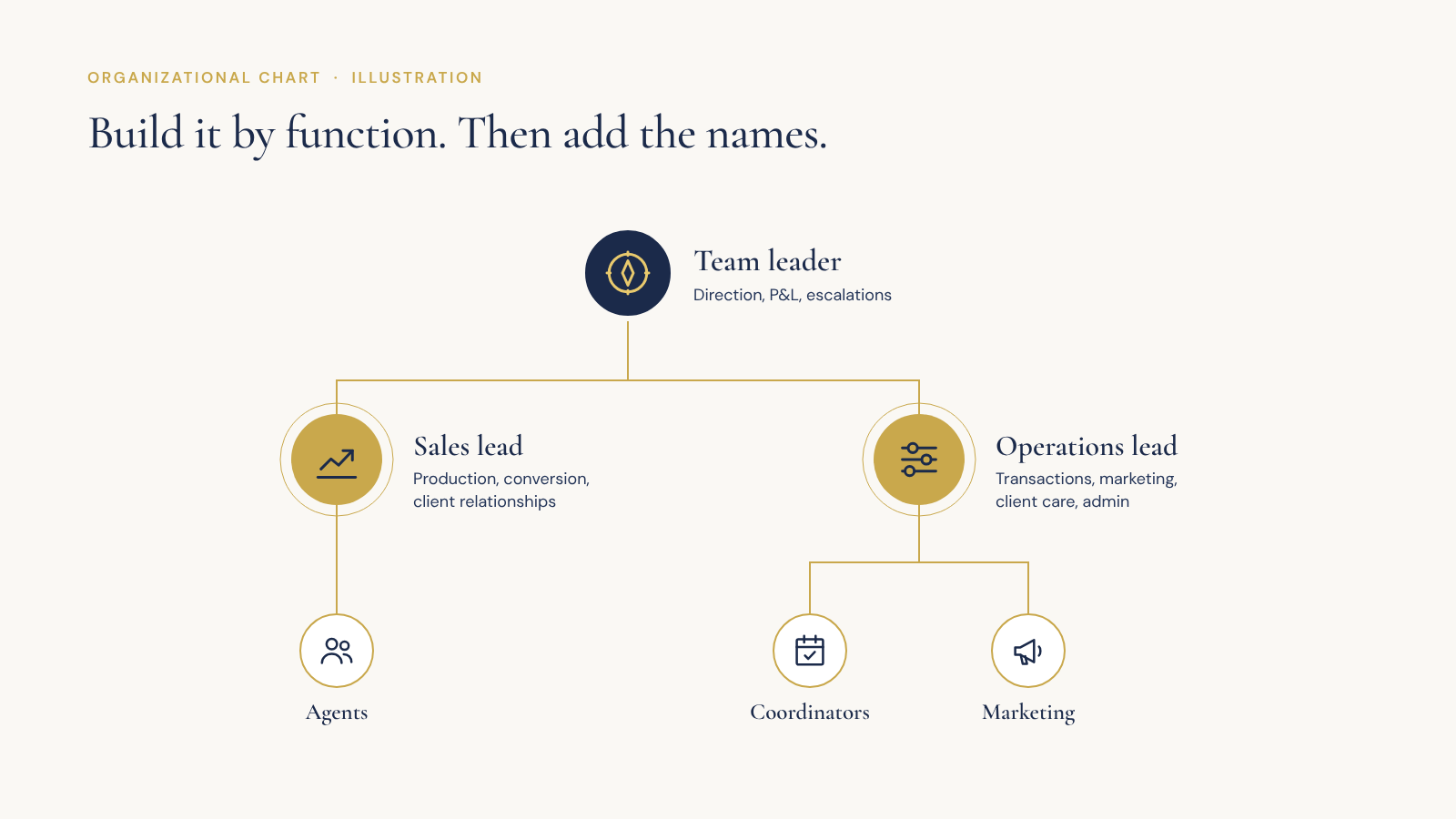
A real estate team organizational chart answers one question: who reviews whose work. Build it by function first, then put names in the boxes.
Here is an illustration for an established team:
- Team leader: owns direction, the P&L, and the escalations named in the decision matrix below.
- Sales lead: owns agent production, conversion, and client relationships through contract. Agents report here.
- Operations lead: owns transactions, marketing execution, client care, and administration. Coordinators and marketing staff report here.
Keep sales and operations reporting separate. An agent reports to the sales lead. A coordinator reports to the operations lead. When the two leads disagree on a file, the decision matrix names who decides.
One person can hold several boxes. On a leaner team, the operations lead also runs transactions and marketing, and you hold the sales lead box yourself. That works when every box lists one name and everyone knows which role is speaking.
Split a combined role into a separate position when the numbers support it. Two signals tell you: the workload exceeds one person’s week, or results slip in one function while its owner covers another.
Assign Authority to Recurring Business Decisions
List the decisions that reach you every week, then give each one an authorized owner and an escalation trigger. Delegated decision authority holds when it is written by decision, one line at a time. This is where your real estate team structure turns from a chart into operating rules.
Build the matrix in five steps:
- Log every decision that reaches you for two weeks.
- Group the log by function: marketing, client service, transactions, agent matters, and money.
- Name the role that decides each recurring item.
- Write the limit and the escalation trigger for each one.
- Review the matrix with your broker, then publish it to the whole team.
This illustration covers four recurring decisions:
| Decision | Authorized Owner | Escalation Trigger |
|---|---|---|
| Marketing spend inside the approved monthly budget | Marketing coordinator or operations lead | Spend above the approved budget, a new channel, or a new vendor contract |
| Client complaint about service or communication | Operations lead, or the sales lead for agent conduct | A fee dispute, a refund request, or a second complaint from the same client |
| Transaction exception, such as a deadline extension or a document correction | Transaction coordinator, with the agent on the file | Any change to price, terms, or commission, or a compliance question for the broker |
| Buyer agreement check before a tour | Operations lead or showing coordinator | A missing or unsigned agreement: the tour holds and the question goes to the sales lead, then the broker |
Write every trigger as an event anyone can see: an amount over budget, a second complaint, a legal question. “Use your judgment” is the trigger that sends every decision back to you.
Each line carries a standard the owner can meet
The matrix names who decides. The standard tells that person what a good decision looks like:
- Marketing spend: set the budget once a month. Inside it, the marketing owner chooses the campaigns and approves the invoices. You review results by lead source on the scorecard.
- Client complaints: the owner responds the same business day and logs the outcome. You read the log, and you step in only on a trigger.
- Transaction exceptions: the coordinator and the agent know the facts and the dates, so extensions and corrections stay with the file. A change to price, terms, or commission is a business decision, and it escalates.
Buyer agreement checks belong to one role
Written buyer agreements make a clean test of the matrix. Under NAR’s practice changes, an MLS participant working with a buyer has needed a written agreement before touring a home, in person or by live virtual tour, since August 17, 2024. The requirement is more than two years old, so treat it as standing procedure.
Assign the pre-tour check to one role. The rule is short: a signed agreement on file before the tour is confirmed. Form content, compliance questions, and disputes stay with your supervising broker. Your team owns the check. Your broker owns the oversight.
Test Whether Decisions Stay Delegated
Delegation holds when decisions stop coming back to you. Measure it before you call the structure fixed.
Track four measures. They are recommendations, and you set the baselines from your own first week of data:
- Owner interruptions: decisions per week that reach you and belong to another role in the matrix.
- Approval delays: hours between a request and a decision.
- Rework: decisions a role owner made that you later reversed or redid.
- Client escalations: complaints that reach you after the role owner handled them.
Add them to your weekly performance measures and review them in the same meeting as your production numbers.
Pilot one function first
Start with one function. Transaction management is a practical first pilot: the volume is high and the exceptions repeat.
Run the pilot for 30 days. At the end, review two effects. For service, look at response times, client escalations, and closings on schedule. For financial effect, look at the cost of rework, the hours you got back, and what those hours produced.
Then adjust the limits. Widen authority where the role owner made sound calls. Tighten it where rework clustered. Move to the next function.
Your overrides decide whether the matrix holds
Every override teaches the team that the matrix is optional. When you reverse a call that sat inside the limit, the next decision comes straight to you.
If a call inside the limit was wrong, change the limit in writing or coach the standard. Leave the authority where it is.
Ken Goodfellow’s definition applies to you first: “Accountability is simply doing what you said you are going to do. That is all.” You said the decision belongs to the role. Team role accountability starts with the leader keeping that commitment.
Review the matrix every month. Ask one question per function: did the owner do what the matrix says? A real estate team structure proves itself in the exceptions, so read the escalation log before you read the chart.
These measures and illustrations carry no guarantee of GCI, profit, or results. Your numbers depend on your market, your team, and your execution.
Your Team Needs Authority to Grow
Your real estate team structure is working when routine decisions get made without you. Three points carry the work:
- Every function has one named owner and one reporting line.
- Every recurring decision has an authorized owner, a written limit, and an escalation trigger.
- Delegation is measured on the weekly scorecard, and the limits change in writing.
If your phone still decides marketing invoices, complaint responses, and deadline extensions, your team has roles and you hold all the authority.
Ken Goodfellow built and sold his own brokerage with approximately 200 agents and has been personally involved in 50+ company sales and succession transactions. His position: a business that depends entirely on the owner is worth far less than one that runs without them.
Coach Ken helps top real estate agents, team leaders, and broker-owners run their businesses like CEOs. That is the work of real estate team coaching. Where the Best Get Better.
Put your structure next to your growth plan. Get Scaling Your Real Estate Business and map your functions, owners, and decision rights before your next hire.