
Your retirement date is a wish until your brokerage can run without you.
Your brokerage is established. You still control recruiting, approvals, and the key relationships. A real estate succession planning timeline built around a calendar date leaves all three with you until the final month.
This guide gives you the milestones that come before the handoff, the proof each one needs, and the order to work them in.
It draws on Ken Goodfellow’s 30+ years of coaching, including 600+ broker-owners and 50+ company sales and succession transactions.
When Should Brokerage Succession Planning Begin?
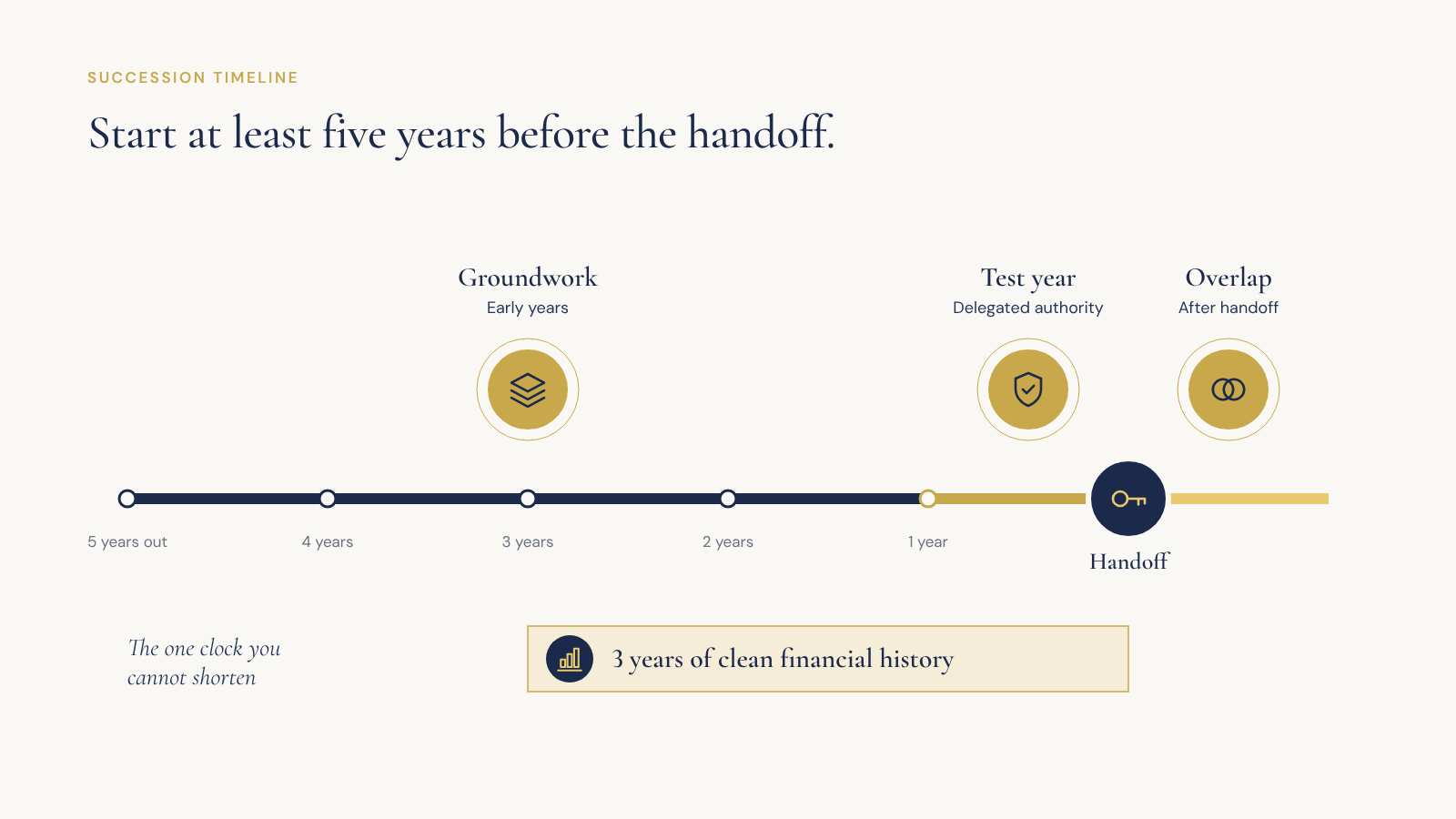
Brokerage succession planning should begin as soon as you own the business, and at least five years before you expect to hand it off. That is CLA’s guidance for real estate companies. It is a recommendation, and no rule sets a mandatory timeline. Your real start date is the day you begin reducing what depends on you.
CLA’s succession guidance for real estate companies also names the cost of waiting. Planning that starts right before an exit can shrink buyer options, lower the value of the company, and weaken the transition.
Five years sounds long. Count what has to happen inside it:
- Three years of clean financial history
- A successor chosen, developed, and tested
- Recruiting and key relationships moved to new hands
- Legal, tax, and license work completed
Each item runs on its own clock. Three years of financial history takes three years.
A workable sequence puts the groundwork in the early years, a test of delegated authority in the final year, and a defined overlap after leadership changes hands. If you are inside five years already, the order holds. The stages get shorter, and the margin for error gets thinner.
Planned succession is also a separate job from emergency continuity. NAR’s succession planning guidance for brokerages covers the emergency plan that protects clients and assets if the managing broker is suddenly incapacitated. Put that plan in place now. This guide covers the handoff you choose.
A Retirement Date Leaves Ownership Questions Unanswered
A retirement date tells your team when you stop. It leaves open who owns the brokerage, who runs it, and who decides. Three mistakes follow from planning by date alone.
Management and ownership are two separate decisions
Who runs the company and who owns the company can change on different days. You can hand daily leadership to a successor and keep your equity. You can sell equity in stages and stay on as an advisor.
Write each change on its own line with its own date. When the two are fused, a strong operator gets passed over because the purchase is out of reach, or a buyer takes control of a team that has never seen them lead.
Four ownership questions stay open until you answer them in writing:
- Who buys the equity, over what period, and with what money?
- Does your successor want to own the company, or only to lead it?
- What role do you keep after the handoff, and for how long?
- What happens to partners and family members who hold a stake?
An untested successor is a guess
A title is a promise. Results are proof. A successor who has never run recruiting, owned the budget, or settled an agent dispute alone has been named and has yet to be tested.
CLA recommends vetting every candidate for experience, technical skill, and alignment with the company’s culture, then investing in training. Successor development is measured in decisions made, with results you can read on the P&L.
Late communication costs you agents
The objection is common: “Agents will leave if I announce succession.” Agents leave when they hear rumors and see no plan. Give them a named leader, a date, and clarity on their splits, support, and brand.
Communicate in stages, and let each stage settle before the next one starts:
- Advisors and co-owners first: your attorney, your CPA, your partners, and family members with a stake.
- The successor and senior leaders next, once roles and dates are in writing.
- Top-producing agents one to one, with the successor in the room.
- The full roster and staff, with the plan and the dates on one page.
- Clients and referral partners, through personal introductions.
In every conversation, cover three points: what changes, what stays the same, and who decides from which date.
CLA’s guidance points the same way: open communication eases the fear and inertia that come with a leadership change.
Readiness Sets the Real Handoff Date
The handoff happens when the business passes its readiness tests. The calendar date follows the evidence.
In succession work, Ken Goodfellow assesses four areas together: founder dependency, leadership strength, successor options, and the founder’s personal financial goals. Each one moves the others. A founder who needs income from the business for ten more years has different successor options than a founder who is financially independent today.
Put one question to each area before you set a date:
- Founder dependency: which decisions, relationships, and approvals still need you?
- Leadership: who ran the last leadership meeting you missed, and what happened?
- Successor options: an internal leader, a family member, a partner, or an outside buyer?
- Personal financial goals: what income do you need from the business, and for how many years?
That combined review is where Succession & Legacy Advisory begins. It examines the organization’s value, leadership structure, founder dependency, potential successors, and the founder’s personal, financial, and legacy objectives before any roadmap is written.
Ken’s standard for a business that is ready to sell has four parts: three years of clean financials, a fully current CRM and database, profitable agents, and systems that run without you. Profitable agents is a numbers test. His target is a 40% profit margin on revenue.
What the company is worth is a separate analysis. See brokerage valuation for what buyers examine before naming a price.
Your real estate succession planning timeline needs evidence
A real estate succession planning timeline with dates and no proof is a calendar. Planning by milestone is common practice. The discipline sits in the proof column, and in naming one accountable owner per line.
This illustration shows the format:
| Milestone | Proof | Accountable Owner |
|---|---|---|
| Financial baseline | Three years of clean financials, closed monthly and reviewed by your CPA | Founder, with the CPA |
| Owner-dependency inventory | A written list of every approval, relationship, and decision that runs through you, with a transfer date beside each | Founder |
| Successor selected | A written role, a development plan, and decision rights signed by the owners | Founder and co-owners |
| Successor-led recruiting | Two consecutive quarters of recruiting run by the successor, with agent retention holding | Successor |
| Budget authority | An annual budget built and managed by the successor, reviewed against the P&L each month | Successor, reviewed by the founder |
| Owner-absence trial | 30 consecutive days away, with a log of any decision that still reached the founder | Leadership team |
| Legal, tax, and license review | Written confirmation of ownership documents, tax plan, and broker of record requirements | Founder, with attorney and CPA |
A milestone closes when the proof exists. If the proof is missing on the target date, the date moves, and the handoff moves with it.
Work the lines in order of lead time. The financial baseline and the inventory start first because they take the longest. The tests come last because they depend on every line above them.
Review the table every quarter with your successor and your advisors. These are the leadership transition milestones that tell you, in writing, how close the handoff is. A real estate succession planning timeline that gets a quarterly review stays honest.
Prove Independence Before Transferring Control
Transfer control after the brokerage has run without you in a test you designed. The work falls into three stages: preparation, a final-year test, and a defined overlap. This is the working part of your real estate succession planning timeline.
Your real estate succession plan starts with preparation
A real estate succession plan starts years before the handoff, with three pieces of groundwork:
- Baseline financials: clean the P&L now. Separate owner pay from profit, remove personal expenses, and close every month on time. Year one of three starts when the books are clean.
- Successor development: hand over authority in steps. A department first, then a budget, then recruiting. Review the results together every month.
- Owner-dependency inventory: list every approval, signature, login, relationship, and decision that runs through you. Put a new owner and a transfer date beside each line.
Key client and referral relationships take the longest to move, so schedule introductions early. The detailed process belongs in a client relationship handoff plan.
The final year tests delegated authority
In the final twelve months, the successor does the job while you still own the outcome. Three tests are recommended here, and you set the pass marks in advance:
- Successor-led recruiting: the successor runs the conversations, the offers, and the onboarding for at least two quarters. You stay out of the room.
- Budget decisions: the successor builds next year’s budget and manages this year’s against the P&L. You review monthly and leave decisions inside the approved limits alone.
- Owner-absence trial: you leave for 30 consecutive days. The team logs every decision that would have come to you. An empty log is a pass.
A failed test is useful. It shows what still depends on you while there is time to fix it. Extend the test, coach the gap, or change the successor’s role. Moving the date costs less than a failed handoff.
Run the broker, legal, and tax review in the same year. Broker of record rules, entity documents, and buy-sell terms vary by state and by company. Your attorney, your CPA, and your state regulator decide what paperwork the transfer requires, so start before the tests end.

The overlap period has defined responsibilities
After leadership transfers, you and the successor work side by side for a set period. Write down who holds what, or the team keeps walking to your office.
- The successor holds daily decisions, recruiting, the budget, and the leadership meeting.
- You hold a short written list: relationships still in transition, advice on request, and ownership matters.
- Both of you hold an agreed review date for the overlap.
Set the length of the overlap by the open items on your list. When the list is empty, the overlap is over, and your role changes to owner, advisor, or retiree by your own choice.
HousingWire’s profile of Cooke Residential shows a staged version. Allison Zimmerman, the daughter of founder Lucia Cooke, has worked in real estate for about 22 years and spent several years as broker in charge of another office while preparing. HousingWire reports that Zimmerman now serves as broker in charge and co-owner, with Cooke shifting responsibilities and still working beside her.
This is an outside example from public reporting, and it has no connection to Coach Ken’s client results. The stages are the lesson: experience earned elsewhere, licensed authority, shared ownership, then a gradual shift of duties.
These milestones and tests are recommendations and illustrations. They carry no guarantee of sale price, profit, or results. Legal, tax, and license questions belong with your attorney, your CPA, and your broker of record.

A Prepared Brokerage Gives You More Control
A real estate succession planning timeline built on proof gives you choices: stay, step back, or sell, on your terms. Carry three points forward:
- Start as early as ownership, and five years ahead where you can.
- Treat management and ownership as separate decisions with separate dates.
- Close a milestone only when its proof exists.
If recruiting, approvals, and key relationships still run through you, that list sets your handoff date, whatever the calendar says.
Ken Goodfellow built and sold his own brokerage with approximately 200 agents. His position: “A business that depends entirely on the owner is worth far less than one that runs without them.” In his view, succession can also mean creating leaders who carry the business forward while you stay involved.
Coach Ken helps top real estate agents, team leaders, and broker-owners run their businesses like CEOs. Where the Best Get Better.
See where your brokerage stands before you set a date. Request your Free Business Evaluation today.