
Lead volume is up. Retained profit is flat.
That gap is a measurement problem. Real estate marketing ROI built on lead counts and GCI tells you which sources are busy. It hides which sources pay.
This guide shows you how to measure profit by lead source: the formula, the deductions, the attribution rules, and the scorecard for moving spend.
It draws on Ken Goodfellow’s 30+ years of coaching, with well over 1,000 teams and 600+ broker-owners coached.
How Do You Calculate Real Estate Marketing ROI?
Calculate real estate marketing ROI by source. Take the contribution a source produced before marketing costs, subtract the marketing investment, divide by the marketing investment, and multiply by 100. Contribution is closed GCI minus agent splits, referral fees, source labor, and transaction costs. Use closed deals only.
ROI = (attributed contribution before marketing – marketing investment) ÷ marketing investment × 100
Each term has a fixed definition:
- Attributed contribution before marketing: closed GCI credited to the source, minus the agent splits, referral fees, source-specific labor, and transaction costs tied to those closings.
- Marketing investment: everything spent to produce and work the source. That covers ad spend, agency and vendor fees, software, content, events, and marketing staff time.
- The result: a percentage. Zero means the source paid back its cost. Below zero means it lost money.
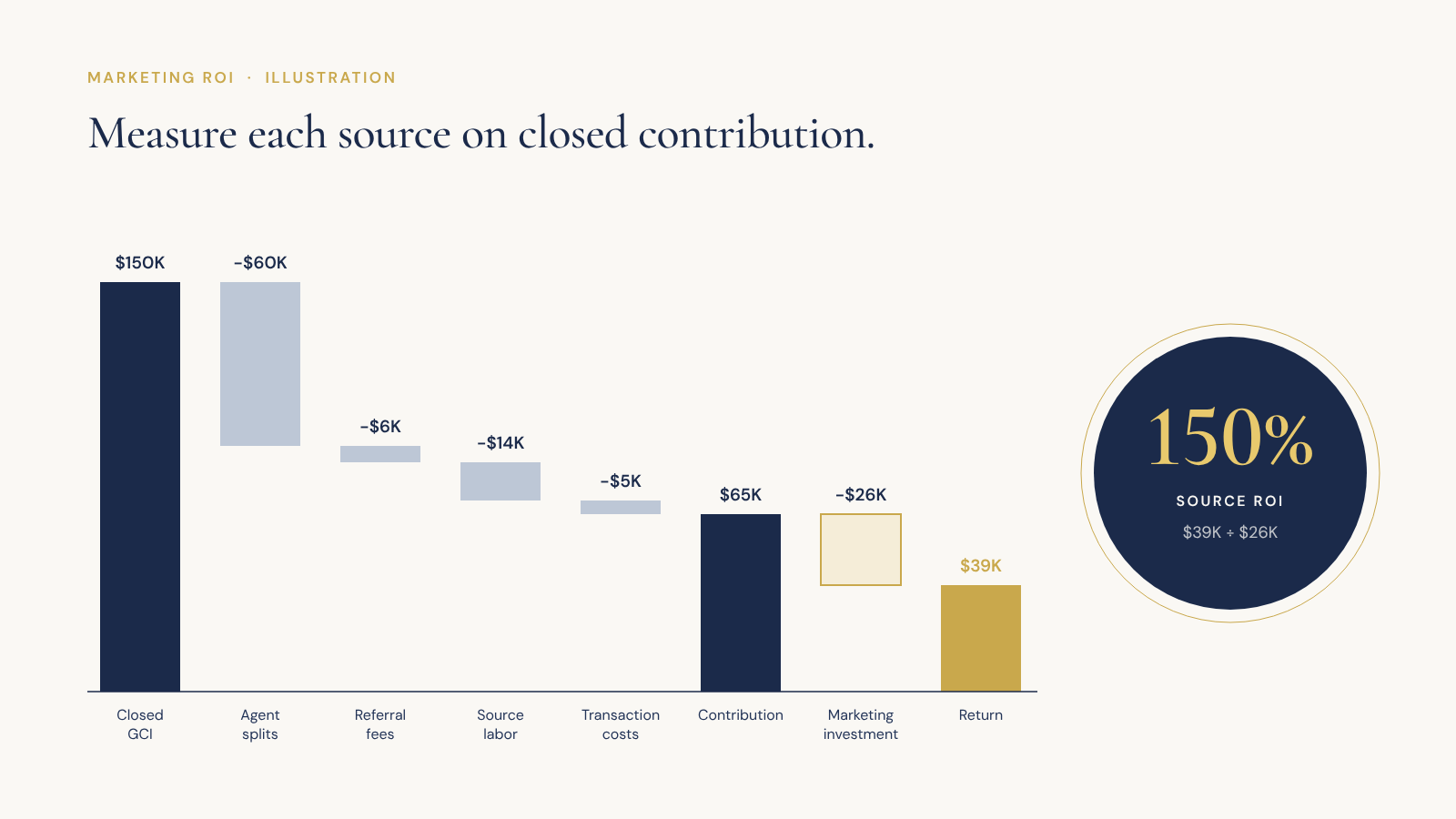
Here is an illustration. A source closes $150,000 in GCI. Subtract $60,000 in splits, $6,000 in referral fees, $14,000 in labor, and $5,000 in transaction costs. Contribution before marketing is $65,000. The source cost $26,000 to run, so ROI is ($65,000 – $26,000) ÷ $26,000 × 100, or 150%.
Put each cost in one place. ISA wages sit in the deductions or in the marketing investment, never in both. A closing belongs to one source.
This is contribution-based ROI. It leaves out fixed overhead such as rent, salaried operations staff, and your own pay. A source with positive ROI still has to help cover that overhead before the company shows a net profit.
Use source ROI to compare sources against each other. Use the P&L to judge the company.
Run the calculation by source, each quarter, on closed business. One blended annual number hides the source that is losing money.
Cheap Leads Can Hide Expensive Closings
Cost per lead tells you what a name costs. It says nothing about what a closing costs or what you keep. A $30 lead that converts at 1% costs $3,000 per closing in media alone, before an ISA, a split, or a coordinator touches it.
That is how real estate marketing ROI gets overstated. Three mistakes turn cheap leads into thin profit, and one objection keeps them hidden.
GCI gets treated as profit
A source that produced $200,000 in GCI did well on the top line. If half goes to agent splits, the company kept $100,000 before any other cost.
Reports that stop at GCI overstate every source. They overstate the high-split sources most.
Splits, referral fees, and labor go missing
Paid leads often carry the highest delivery cost: an ISA to qualify them, an agent on a team split to work them, and a coordinator to close them.
Outbound referral fees work the same way. A 25% referral fee on a closing comes off the top, before your split math starts.
Leave those costs out, and a source that barely breaks even looks like your best performer.
Pending deals get counted as revenue
A pending deal is a forecast. Some close late, and some fall through. Count revenue on the closing date, and track pendings in a separate pipeline column.
Your agency’s ROI uses a different equation
The objection is fair: “My agency already reports ROI.” Ask for two definitions before you accept the number.
First, the denominator. Is it ad spend only, or ad spend plus the agency fee and software? Second, the revenue. Is it closed GCI, pending GCI, or an estimated value per lead?
Here is an illustration. An agency reports $200,000 in GCI on $45,000 of ad spend and calls it a 4.4x return. That figure is return on ad spend. Add a $12,000 agency fee and $3,000 of software, subtract splits, ISA labor, and transaction costs, and the same campaign returns about 7%.
The agency report answers a media question. Your report has to answer a profit question.
Match Source Costs With Realized Contribution
Put every source through the same equation, with complete costs on one side and closed contribution on the other. Then read the result next to your P&L.
With every new client, Ken Goodfellow reviews the P&L first, then the economics behind the marketing line. His position: “Low profit is always more dangerous than low revenue.” He names three places profit leaks: agent splits, marketing overspend, and payroll.
Keep two numbers apart. Ken’s target is a 40% profit margin on revenue for the whole company, after every cost. Source ROI is a campaign-level ratio. A source can show strong ROI while the company misses the margin target, because overhead sits outside the source math.
That is why Strategic Advisory begins with a review of financial performance and marketing together.
Your real estate lead generation ROI needs complete costs
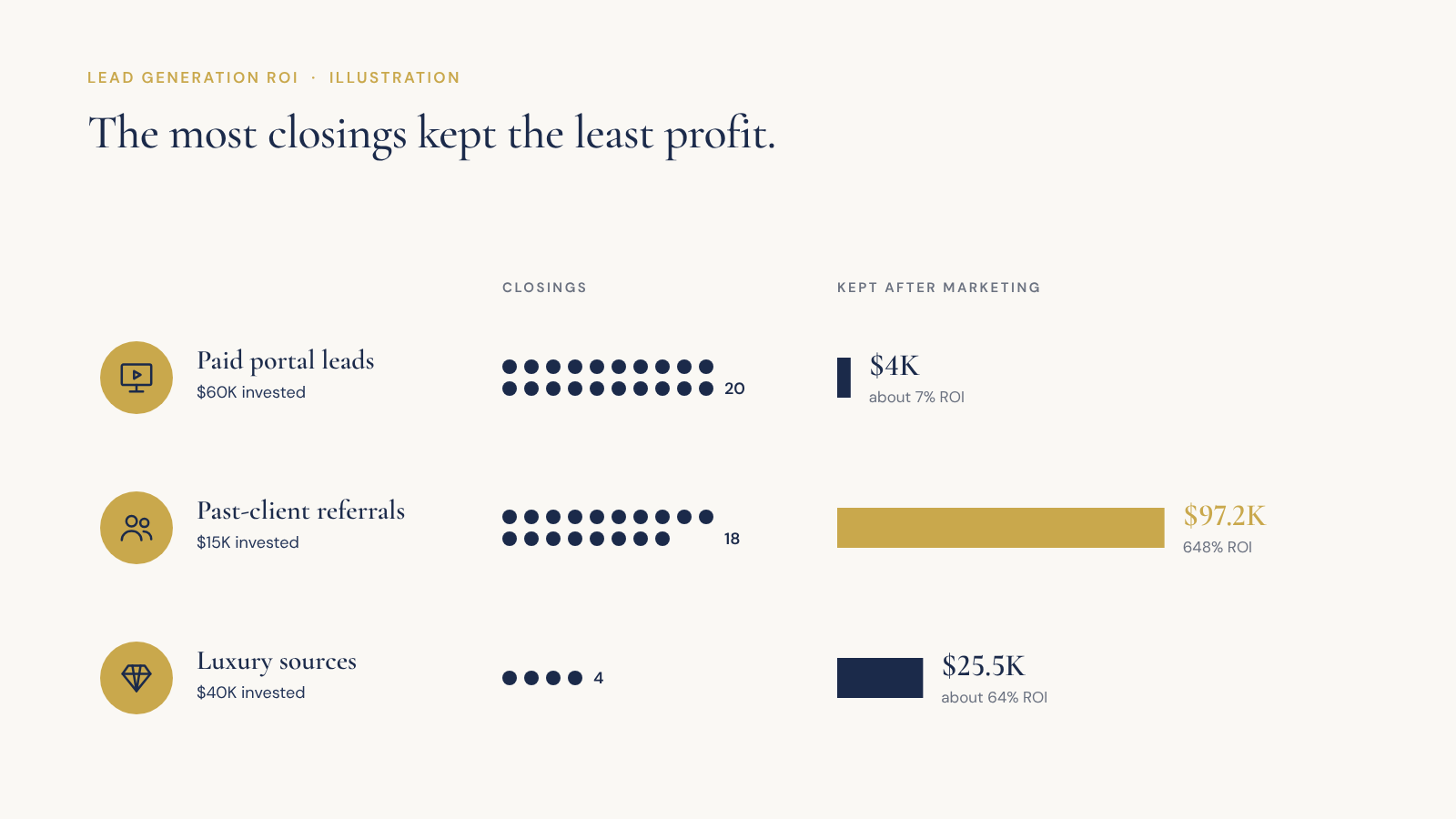
Real estate lead generation ROI changes sharply once delivery costs are in. These three sources are illustrations with round numbers, each measured over one mature 12-month cohort:
- Paid portal leads: $60,000 invested, 20 closings, $200,000 GCI. After $100,000 in splits, $30,000 in ISA labor, and $6,000 in transaction costs, contribution is $64,000. ROI: about 7%.
- Past-client referrals: $15,000 invested in events, mailings, and database work. 18 closings, $216,000 GCI. After $86,400 in splits, $12,000 in labor, and $5,400 in transaction costs, contribution is $112,200. ROI: 648%.
- Luxury sources: $40,000 invested in print, events, and agent networks. 4 closings, $180,000 GCI. After $72,000 in splits, $22,500 in outbound referral fees, and $20,000 in listing preparation, contribution is $65,500. ROI: about 64%.
Read them together. Paid leads produced the most closings and the least retained profit: $4,000. Referrals retained $97,200. The luxury source closed four deals and retained $25,500.
Marketing cost per closing tells the same story from another angle: $3,000 for paid leads, about $833 for referrals, and $10,000 for luxury. The luxury figure looks high until you set it against $45,000 in average GCI per closing.
Your numbers will differ. The method stays the same: full investment, closed GCI, every deduction, and one source per deal.
Attribution Needs Consistent Rules and Closing Cohorts
ROI by source is only as good as the source field in your CRM. Lead source attribution needs fixed rules, applied the same way every month.
Capture six fields on every lead and every closing:
- Source
- Campaign
- Acquisition date
- Closing date
- GCI
- Deductions: splits, referral fees, labor, and transaction costs
Keep unknown as a source. When the field is blank, record it as unknown and report the total. A growing unknown line tells you the intake process is broken. Spreading those deals across other sources hides the problem.
One closing gets one source
A past client clicks a paid ad, then calls the agent directly. Three sources can claim that closing: the past-client database, the ad, and the agent’s sphere.
Pick one rule, such as the source that created the relationship. Write it down and apply it every time. Google’s attribution models do the same job inside its own platform: a model is a rule for how much credit each ad interaction receives. Your CRM needs one rule across all sources.
Mature cohorts get judged, and pipeline gets watched
Group leads by the month or quarter you acquired them. A cohort is mature when enough time has passed for its deals to close. For many teams that is 12 months, and longer for luxury and sphere business.
Calculate ROI on mature cohorts only. Report younger cohorts as pipeline, with pendings shown separately.
One limit applies to all of it. Attribution establishes credit. It stops short of proving the spend caused the deal, because some referral clients would have called you anyway. To test cause, change one variable: pause a source in one area for a quarter and compare the closings.
The source report reconciles to the P&L
Run one check every month. Total GCI across all sources, unknown included, equals closed GCI on the P&L. Total marketing investment across sources equals the marketing lines in your books.
Shared costs, such as the CRM and a marketing coordinator, get allocated by one fixed rule, such as each source’s share of leads handled. Keep the rule the same all year. If the totals disagree, fix the data before you move a dollar.
Reallocate Spend After Testing Payback and Capacity
Move money toward sources with strong retained contribution and fast payback. Move it in steps, and only as far as your team can service the volume. This is where real estate marketing ROI becomes a budget decision.
Score every source on four measures:
| Measure | How to Calculate It | What It Tells You |
|---|---|---|
| Marketing cost per closing | Marketing investment ÷ closings | What one closed deal costs to acquire |
| Retained contribution | Contribution before marketing, less the marketing investment | The dollars a source leaves for overhead and profit |
| ROI | Retained contribution ÷ marketing investment × 100 | The return on each dollar invested |
| Marketing payback period | Months until cumulative contribution equals the investment | How long your cash is tied up |
Payback matters because cash matters. A source that returns its cost in four months can be funded again within the same year. A source that takes fourteen months ties up cash across two budget cycles.
Then sort each source into one of three decisions:
- Fund: retained contribution is strong, payback is inside your cash plan, and the team has capacity.
- Fix: the closings are there, and the deductions are eating the contribution. Lower the delivery cost before you add spend.
- Stop: a mature cohort shows negative ROI, and no fix is in view.
Capacity sets the ceiling
A source with strong ROI can still fail at double the spend. Referral business grows with service and follow-up, so extra ad dollars leave it unchanged. Paid volume needs ISA hours and agent time.
Before you add spend, confirm who works the extra leads and what that labor adds to the deductions. As a recommendation, shift 10% to 20% of spend per quarter, then measure the next mature cohort. Large swings blur what changed the result.
Put the added labor into the equation first, then recalculate. If ROI holds with that cost included, the source has room to grow.
Ad platforms should learn from closings
Popular and profitable are separate questions. In NAR’s 2025 Technology Survey, 39% of Realtors named social media as the technology producing their highest number of quality leads, and 23% named their CRM. Those figures report lead quality as agents see it. They say nothing about profit.
The ad platforms have moved toward closed-deal data as well. In April 2026, Google combined enhanced conversions for web and leads into a single setting. Since June 15, 2026, offline conversion uploads run through its Data Manager API.
Enhanced conversions for leads lets you send offline outcomes back to Google Ads. Ask your agency one question: are the campaigns optimizing toward closings, or toward form fills?
The examples and measures in this guide are illustrations and recommendations. They carry no guarantee of GCI, profit, or results in your business.
Fund Sources That Produce Retained Profit
Real estate marketing ROI is a profit measure. Lead counts and GCI are activity measures. Hold on to three points:
- Measure contribution after splits, referral fees, labor, and transaction costs.
- Judge mature cohorts of closed deals, with one source per closing.
- Move spend in steps, toward retained contribution and faster payback.
If your marketing line grows every year and your take-home stays flat, your reports are counting leads while your P&L counts profit. Ken’s position holds here: profit matters more than revenue.
Coach Ken helps top real estate agents, team leaders, and broker-owners run their businesses like CEOs. Where the Best Get Better.
Find out where your profit is going. Request your Free Business Evaluation today.