
Your GCI is the number you quote. A buyer will pay for a different one.
Real estate brokerage valuation starts with the earnings a new owner can keep after you leave. High gross commissions tell a buyer the firm is busy. They leave open how much of that income transfers.
This guide shows you what buyers examine before naming a price: the earnings they count, the risks they discount, and the proof they expect.
It draws on Ken Goodfellow’s 30+ years of coaching and his personal involvement in 50+ company sales and succession transactions.
How Is a Real Estate Brokerage Valued?
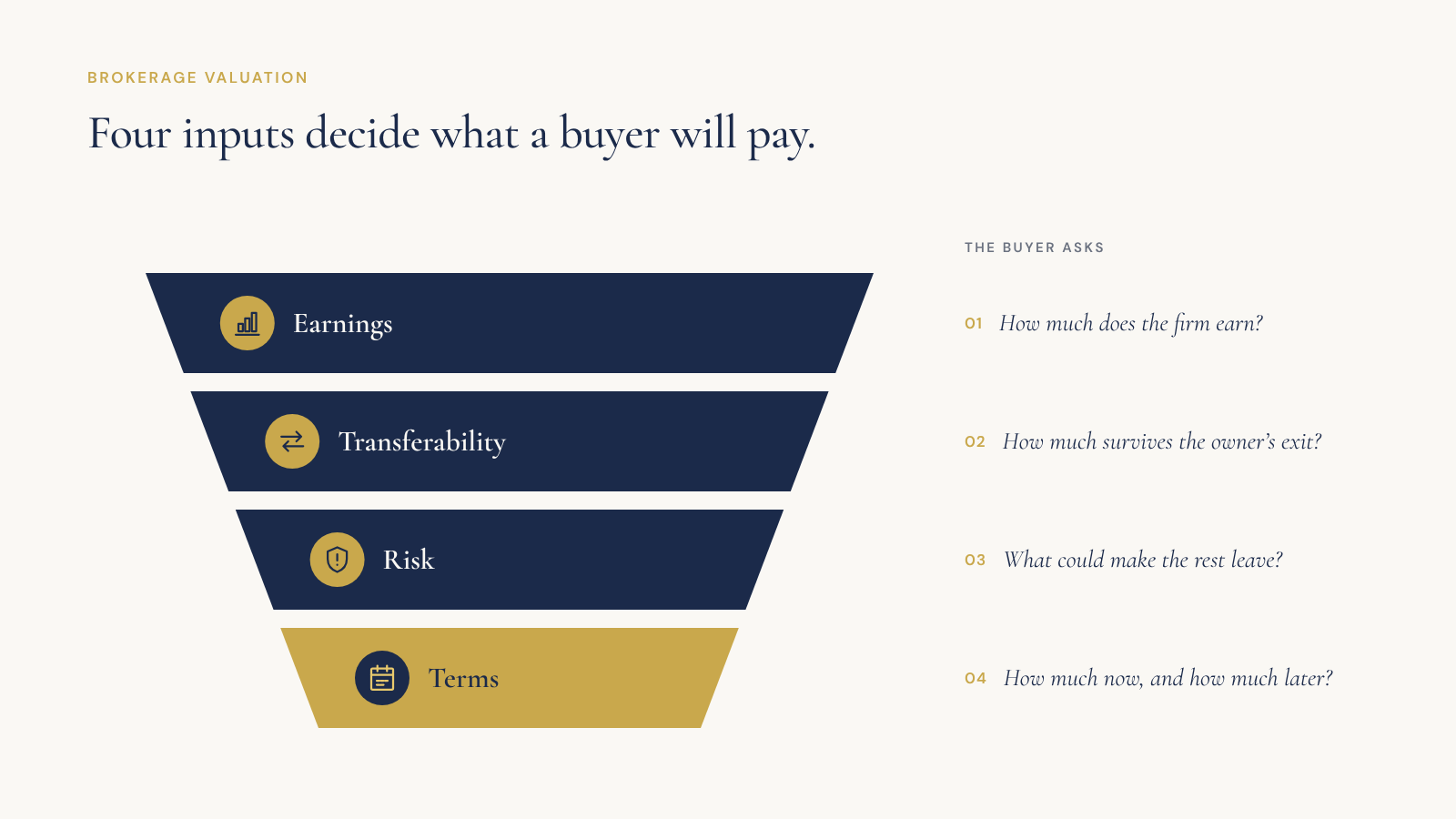
A real estate brokerage is valued on four inputs: the earnings it produces, how much of those earnings transfers to a new owner, the risk that agents or income leave after the sale, and the payment terms. Buyers apply a multiple to normalized earnings or a percentage to company revenue, then adjust for risk.
Earnings come first because a buyer has to know how much cash the firm produces before deciding what to pay and how to finance it. Transferability and risk decide how much of that cash the buyer trusts. Terms decide when you get paid.
A buyer works through them as four questions, in order:
- How much does the firm earn?
- How much of that survives the owner’s exit?
- What could make the rest leave?
- How much do I pay at closing, and how much later?
This guide is educational. A formal valuation is the work of a qualified valuation professional, and tax and legal questions belong with your CPA and attorney.
Gross Commissions Overstate What the Buyer Keeps
GCI is the top of a ladder, and the buyer is pricing a rung near the bottom. Five numbers sit between your headline and your bank account:
- GCI: total commission income before anyone is paid.
- Company dollar: what the firm keeps after agent commissions, referral fees, co-brokerage fees, and franchise fees.
- Normalized EBITDA: company dollar less operating expenses, adjusted to show what a new owner would earn.
- Enterprise value: the price a buyer places on the business.
- Seller proceeds: what reaches you after debt, taxes, fees, and any contingent payments.
In the illustration used later in this guide, $12 million in GCI becomes about $2.16 million in company dollar and $330,000 in normalized EBITDA. That is less than three cents of transferable earnings for every dollar of GCI.
Three mistakes come from mixing these numbers up.
Sales volume describes activity
Volume is the total price of the homes sold. It says how active the firm is and leaves earnings out entirely. Two firms with the same volume can keep different amounts of company dollar, depending on their splits and fees.
A borrowed multiple belongs to another firm
A multiple you heard at a conference was attached to someone else’s earnings, risk, and terms. Applied to your reported profit, it produces a number no buyer agreed to.
Owner pay is only partly an add-back
Owners often add back every dollar they take out. Buyers add it back too, then subtract what it costs to replace you. RealTrends describes the standard treatment: owner compensation and one-time expenses go back in, and the cost of comparable management and the owner’s own commission contribution come out.
Transferable Earnings Establish the Starting Point
The starting point is the profit a new owner would earn with you gone and a paid manager in your seat. Build that number yourself, with documents, before a buyer builds it for you.
Your real estate brokerage valuation needs normalized earnings
A real estate brokerage valuation rests on a bridge from reported profit to normalized EBITDA. This illustration uses round numbers for a firm with $12 million in GCI:
| Adjustment | Amount | Evidence a Buyer Expects |
|---|---|---|
| Reported profit before income taxes | $300,000 | Trailing 12-month P&L that ties to the tax return |
| Add depreciation, amortization, and operating interest | + $40,000 | The same P&L and loan statements |
| Add owner compensation and benefits | + $250,000 | Payroll records and benefit invoices |
| Add documented one-time expenses | + $60,000 | Invoices for the office move and the legal matter |
| Subtract replacement management cost | – $180,000 | A market salary for a manager who does the owner’s job |
| Subtract the owner’s own production | – $120,000 | Company dollar from the owner’s deals, by closing |
| Subtract one-time income | – $20,000 | The entry and the reason it will stay a one-time event |
| Normalized EBITDA | $330,000 | A one-page schedule with every document attached |
The owner in this illustration expected credit for $650,000: profit plus pay plus the one-time costs and non-cash items. The documented figure is $330,000. The gap is the owner’s job and the owner’s own deals.
Two rules keep the bridge credible. Every add-back has a document, and personal production sits on its own line. If you list and sell, a buyer assumes that income leaves when you do.
Be strict about what counts as a one-time expense. A legal settlement, an office relocation, or a software conversion qualifies when it has an invoice and will stay a single event. A cost that returns every year under a new name fails the test, and a buyer who finds one will question the rest of the schedule.
Calculate your own production the same way for each of the past three years: the company dollar from your personal closings, less any commission the firm paid you on them. A steady or falling share works in your favor. A rising share tells the buyer the firm is becoming more dependent on you.
Different brokerage valuation methods require different evidence
Two brokerage valuation methods are in common use, and RealTrends describes both:
- The income approach: a multiple applied to normalized EBITDA, usually for the most recent 12 months. It needs clean financials and a documented bridge.
- The company revenue approach: a percentage applied to company dollar. It needs a reliable split and fee history by agent.
- The choice between them: RealTrends notes the revenue approach is used when a firm has little or no earnings, is small, or depends on the owner for a large share of revenue.
Each method has a limit. An EBITDA multiple misleads when earnings are thin or rest on the owner. A percentage of company dollar ignores whether the firm turns that revenue into profit.
Skip any rule of thumb that names one multiple for every brokerage. The multiple is an output of your risk profile, which is the next section.
Buyer Risk Changes the Price
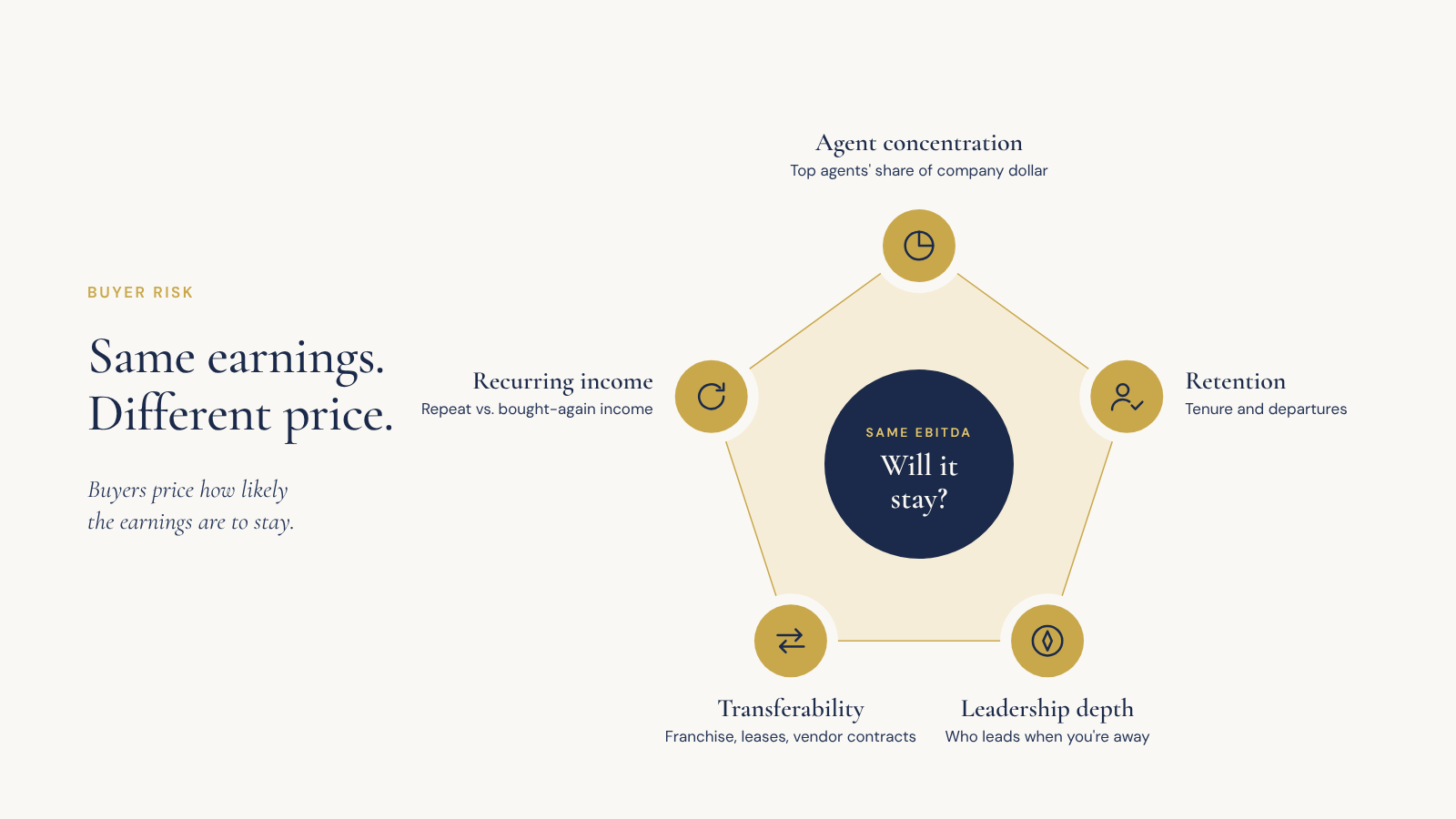
Two firms with the same normalized EBITDA can receive different offers. The difference is how likely the earnings are to stay after closing. Buyers test five areas:
- Agent concentration risk: the share of company dollar produced by your top agents. If a handful of people produce most of it, one departure changes the deal.
- Retention: agent count, tenure, and departures over the past three years, and why each agent left.
- Leadership depth: who recruits, coaches, and settles disputes when you are away.
- Franchise and contract transferability: whether the franchise agreement, the leases, and key vendor contracts can pass to a new owner, and on what conditions.
- Recurring-income quality: how much income repeats from past clients, referrals, and affiliated services, compared with income that must be bought again each year.
Ken Goodfellow’s standard for a business that is ready to sell covers the same ground in four parts: three years of clean financials, a fully current CRM and database, profitable agents, and systems that run without you.
His position on the last part is direct: “A business that depends entirely on the owner is worth far less than one that runs without them.” That preparation is the focus of Succession & Legacy Advisory, which reviews the organization’s value, leadership structure, and founder dependency before a transition.
Run the concentration test today. Rank your agents by company dollar for the past 12 months. Add up the top five. The larger their share, the more a buyer will tie the price to those agents staying.
Each of these risks moves a real estate brokerage valuation without changing a dollar of earnings, and each has a fix that takes time. Concentration eases as you recruit and develop the middle of the roster. Leadership depth comes from naming a manager and testing that person with real authority. Transferability starts with reading the assignment clauses in your franchise agreement and leases this quarter.
Recent Earnings Need Context
Buyers read your latest 12 months against the industry around you. Thin margins are normal in brokerage right now, and how you earned yours matters as much as the figure.
AccountTECH’s benchmark study of 157 brokerage companies found the median EBITDA margin rose from 1.35% of income in 2024 to 1.68% in 2025. The gain came from expense cuts. Median gross profit fell over the same period, while operating expenses fell further.
That matters in a negotiation. Earnings that improved through cost cuts raise a question: can the firm hold those costs and still recruit, support agents, and grow? Earnings that improved through higher company dollar per agent are easier to defend.
Treat the AccountTECH figures as a sample benchmark for brokerage companies, measured against total income. Ken’s 40% profit margin target is a different measure on a different base, so the two numbers should never be set side by side.
Market conditions shape terms as well. In its 2025 commentary, RTC Consulting observed that the multiples and percentages buyers pay had held up, while overall valuations dropped because brokerage earnings were weaker. It also described fewer active buyers with less capital, which affects the terms on offer.
The lesson for a seller is practical. You control your earnings and your risk profile. You have little control over how many buyers are in the market in the year you decide to sell.
Prove Value Before Defending Your Asking Price
An asking price is a claim. Evidence makes it a negotiation. Bring the proof before the buyer asks for it.
A competitor’s multiple is three numbers
The objection comes up in nearly every sale: “My competitor received a higher multiple.” Compare three items before you rely on it:
- The earnings definition: a multiple of reported profit and a multiple of normalized EBITDA are different prices.
- The risk: their concentration, retention, and leadership depth may have been stronger.
- The payment terms: RealTrends notes that all-cash deals at full value are close to nonexistent in residential brokerage. Part is paid at closing, and the rest arrives through an earn-out or other contingent payments.
A higher headline with a long earn-out can pay less than a lower price with more cash at closing. The detail on brokerage earnouts deserves its own review.
Public deals rarely settle the argument. RTC Consulting advised Cottingham Chalk on its 2025 sale to Compass, and the price and terms were undisclosed. The deal shows that a buyer existed. It tells you nothing about a multiple.
The proof runs to a few pages
Prepare four items: the normalized earnings bridge with documents, a concentration table by agent, a three-year retention history, and a one-page summary of what transfers. The full process of selling a brokerage builds on those four.
The examples in this guide are illustrations. They carry no guarantee of price, proceeds, or results, and your figures will depend on your firm, your market, and your buyer.
Real estate brokerage valuation rewards the owner who prepares early. Keep three points:
- Buyers price transferable earnings, and GCI is only where the math begins.
- Risk moves the price as much as earnings do.
- Headline price and seller proceeds are separate numbers.
If you can quote your GCI from memory and would need a week to produce your normalized EBITDA, a buyer will find the gap before you do.
Ken Goodfellow built and sold his own brokerage with approximately 200 agents. Coach Ken helps top real estate agents, team leaders, and broker-owners run their businesses like CEOs. Where the Best Get Better.
Start with a clear view of the business. Request your Free Business Evaluation today. It is a business assessment, and a formal valuation remains the work of a valuation professional.